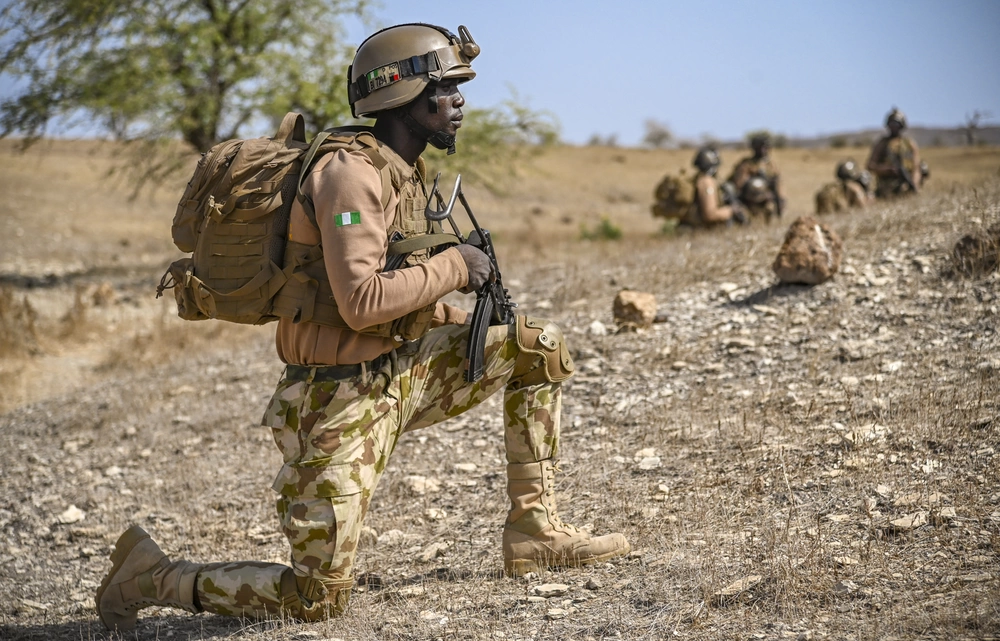
Abuja (Diplomat.so) - Nigerian Armed Forces troops working with Air Force surveillance units and local auxiliary forces killed at least 18 militants during coordinated operations in Borno State on Wednesday, 29 April, targeting Boko Haram-linked hideouts across Bulabulin forest and Timbuktu axis.
Coordinated military offensives
Military spokesperson Sani Uba confirmed that 11 militants were killed in Bulabulin forest and seven others in the Timbuktu operational axis during simultaneous ground and air-supported offensives aimed at dismantling insurgent supply routes and command enclaves.
Uba said in a statement that the operations were based on intelligence-led targeting and continued pressure following recent attacks on military installations in the region.
"The troops, in collaboration with Air Force platforms and local support groups, conducted precision strikes on identified terrorist enclaves, neutralising 18 insurgents in total,” Uba said.
He added that follow-up clearance operations were ongoing to track fleeing fighters and dismantle remaining logistical networks used by armed groups operating in the region.
Air support and pursuit operations
Military sources indicated that surveillance aircraft provided real-time intelligence that guided ground troops through dense forest terrain, where militants have historically established fortified hideouts.
Residents in nearby communities reported hearing sustained aerial activity and intermittent explosions during the early hours of Wednesday.
"We heard helicopters circling for hours, then loud blasts deeper inside the forest. Later, soldiers passed through the village in armored vehicles,” said a resident of a community near Konduga, who requested anonymity due to security concerns.
Security analysts note that the Timbuktu and Bulabulin corridors remain strategic infiltration routes for insurgent movement across the northeastern theatre, where terrain complexity has long challenged sustained clearance operations.
Chibok survivors
In a separate development underscoring the region’s long conflict trajectory, 12 survivors of the 2014 Chibok school abduction are set to graduate from the American University of Nigeria in Yola, Adamawa State.
The American University of Nigeria (AUN) President Prof Dewayne Frazier described the graduation milestone as a symbol of resilience and institutional commitment to recovery through education.
"The graduation of several students who were formerly held captive in the Sambisa Forest symbolises more than academic achievement; it is a global testament to resilience, hope, and the indomitable human spirit,” Frazier said during a press briefing on campus.
He added that their academic progress demonstrates the university’s mission in bridging trauma recovery with higher education access, noting that their journey has drawn global attention.
A university official, speaking on condition of attribution, said the graduating cohort represents "one of the most powerful transformations of survival into leadership potential seen in recent years.”
Human impact
In Maiduguri, some residents expressed cautious optimism over renewed military operations but emphasized the need for sustained protection of rural communities.
"We want peace that lasts, not just announcements after operations. Many villages are still afraid to farm,” said a trader at Baga Road market.
Humanitarian workers operating in displacement camps noted that while security pressure on armed groups is increasing, civilian vulnerability remains high in remote settlements where access to services is limited.
long-running insurgency in northeast
Borno State has endured 17 years of insurgency linked to Boko Haram and Islamic State West Africa Province factions, resulting in thousands of deaths and the displacement of an estimated two million people.
The Chibok abduction of 276 schoolgirls in 2014 remains one of the most widely documented mass kidnappings in the conflict, with several victims still unaccounted for despite rescue and escape cases over the years.
Military campaigns have oscillated between territorial gains and renewed insurgent attacks, reflecting the adaptive nature of armed groups operating across the Lake Chad Basin.
Diplomat News Network reporting indicates that recent military operations form part of an intensified counterinsurgency phase following attacks on forward bases earlier this year.
Sustained pressure
The latest military operations highlight continued efforts by Nigerian security forces to disrupt insurgent mobility across forested strongholds that have historically enabled regrouping and cross-border coordination.
At the same time, the graduation of Chibok survivors reflects a parallel narrative of long-term recovery emerging from one of the region’s most traumatic security episodes.
Together, the developments underscore a dual reality in northeastern Nigeria: persistent military confrontation with armed groups alongside gradual social reconstruction efforts led by educational and humanitarian institutions.