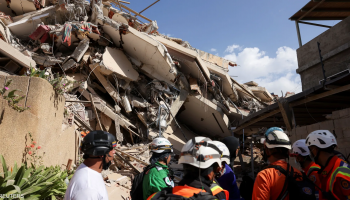
Paris (Diplomat.so) – International Energy Agency Executive Director Fatih Birol stated that more than 40 energy assets across nine Middle Eastern countries have suffered "severe or very severe" damage following the U.S.-Israeli war on Iran, during a recent speech in Canberra, Australia, on the global energy outlook.
In his address to the National Press Club, Birol warned that oil fields, refineries, and pipelines affected by the conflict will require extended periods to resume full operations, noting that disruptions to supply chains have persisted for more than three weeks amid heightened volatility in global energy markets. He emphasized that the temporary near-closure of the Strait of Hormuz contributed to sharp increases in oil, natural gas, and fuel prices, affecting both producers and consumers worldwide.
According to reporting by Bloomberg, Birol compared the current disruption to a combination of the major oil shocks of the 1970s and the 2022 energy crisis following the Russia–Ukraine war, underscoring the scale of the impact on interconnected energy systems. He also cautioned that the effects extend beyond crude oil and gas to petrochemicals, fertilizers, sulfur, and helium, sectors that underpin multiple industrial supply chains.
In remarks cited by Reuters, Birol said the agency is in consultations with governments in Asia and Europe regarding the potential release of additional strategic reserves if conditions deteriorate further. He noted that IEA member countries had already agreed on March 11 to release 400 million barrels from strategic stockpiles, representing approximately 20% of total reserves.
"There is no fixed price level that automatically triggers further releases,” Birol said, adding that while stockpile withdrawals could help stabilize markets in the short term, "the only lasting solution is restoring safe passage through the Strait of Hormuz.” Diplomat News Network understands that similar concerns have been echoed in internal briefings among energy policymakers monitoring maritime chokepoints.
On the ground, traders and logistics operators described heightened caution in shipping routes. A regional fuel distributor, speaking on condition of anonymity, said vessel insurance premiums have increased and delivery schedules have become less predictable. "We are seeing delays at ports and tighter inventories,” the distributor said, adding that procurement cycles are being adjusted to account for uncertainty.
Birol highlighted that Asia-Pacific economies are among the most exposed due to their reliance on imports of crude oil and key industrial inputs transported through the Strait of Hormuz. He also pointed to demand-management measures previously used in Europe in 2022, such as remote work and speed reductions, as potential short-term responses to ease pressure on consumption.
Birol estimated that the global market has effectively lost access to around 11 million barrels per day of supply due to the conflict, a level he described as exceeding the combined impact of previous major crises. The disruption carries broader implications for inflation, industrial production, and energy security, particularly for import-dependent economies.
The developments underscore the vulnerability of global energy systems to geopolitical instability in strategically critical transit corridors, with policymakers now weighing both immediate stabilization tools and longer-term structural resilience measures.