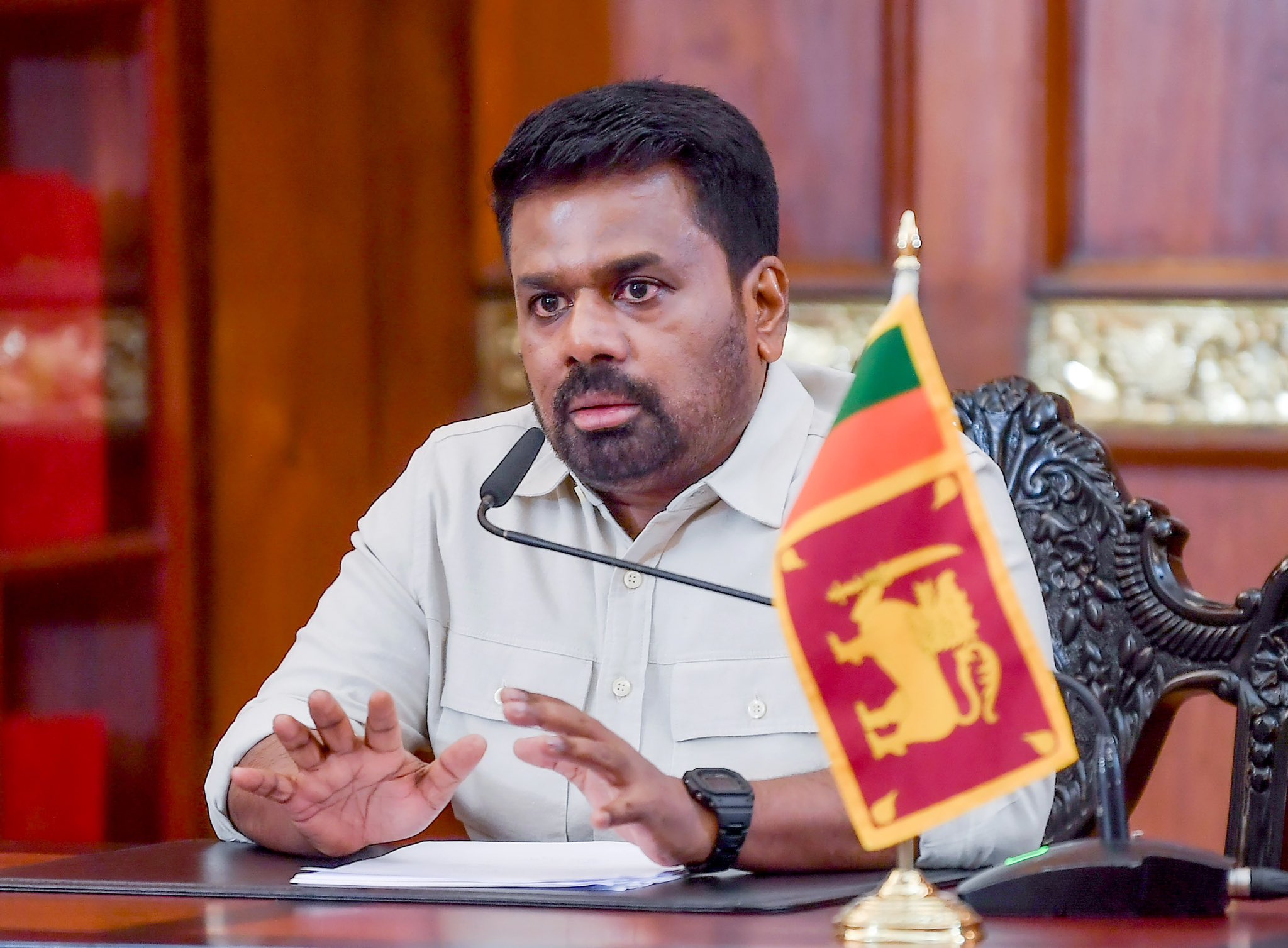
Colombo (Diplomat.so) - Anura Kumara Dissanayake, President of Sri Lanka, informed parliament that the government rejected a request from the United States to allow two military aircraft to land at Mattala Rajapaksa International Airport, citing concerns over maintaining the country's neutrality.
Dissanayake made the statement during a parliamentary session held on Friday, outlining that the U.S. request had been submitted on February 26. The request sought permission for two armed aircraft equipped with anti-ship missiles to land at the southern airport between March 4 and March 8, after departing from a U.S. base in Djibouti. According to his remarks, the government assessed the request and declined it to avoid compromising Sri Lanka’s non-aligned foreign policy.
He further told lawmakers that the administration had reviewed a separate request from Iran, also submitted on February 26, involving three naval vessels seeking a friendly port visit between March 9 and March 13. That request was likewise rejected. Dissanayake explained that both requests were considered in tandem, and approval of one would have created expectations of equal treatment for the other.
"We were examining the requests, but if we had approved the Iranian request, we would have had to approve the U.S. request also,” he said in parliament, emphasizing that the government aimed to apply consistent standards across all diplomatic and military access requests.
A resident living near Mattala Rajapaksa International Airport in southern Sri Lanka said the issue has drawn local attention but remains secondary to economic concerns. "Most people here are more focused on daily livelihoods, but they do notice when international military matters involve the area,” the resident said.
Mattala Rajapaksa International Airport, situated in the south of the country, is a relatively underutilized facility, and decisions regarding its use for foreign military or diplomatic purposes are often treated with caution by authorities due to potential geopolitical implications.
The developments coincided with maritime incidents reported earlier in the month. The Sri Lanka Navy conducted a rescue operation on March 4, saving 32 crew members from the Iranian vessel IRIS Dena after it was destroyed by a torpedo launched from a U.S. submarine, according to details referenced in official accounts. The survivors were brought ashore and received assistance from Sri Lankan authorities.
The reported torpedo strike on the Iranian vessel Dena, described by U.S. Secretary of War Pete Hegseth as a "quiet death,” is considered the first operation of its kind carried out by the United States since World War II, and is viewed by observers as an indication of the expanding geographic scope of the conflict.
In a separate incident, the navy also assisted another Iranian vessel, the IRIS Bushehr, whose crew faced technical difficulties outside Sri Lanka’s territorial waters. Officials said the operation formed part of routine maritime safety and search-and-rescue responsibilities in nearby international sea lanes.
According to an internal cable from the U.S. Department of State, Washington pressed the Sri Lankan government not to repatriate survivors from the Iranian vessel that was destroyed by the U.S. submarine, as well as the crew of another Iranian ship held by Sri Lanka.
The cable, dated March 6, stated that Jane Howell, the Chargé d’Affaires at the U.S. Embassy in Colombo, conveyed to Sri Lankan authorities that neither the crew of the Bushehr nor the 32 survivors from the Dena should be returned to Iran.
Separately, Iranian Deputy Foreign Minister Saeed Khatibzadeh, speaking in New Delhi, said the vessel that was destroyed by the United States was "unarmed” and "carried no cargo.” He added that it had participated in an international naval exercise at the invitation of partners in India, describing its presence as "ceremonial” in nature.
Sri Lanka’s current position reflects an ongoing effort to stabilize its economy after the 2022 financial downturn, which significantly reduced foreign currency reserves and increased reliance on external support, while simultaneously managing indirect economic pressures linked to broader regional instability driven by intensified United States–Israel military strikes against Iran and preserving a balanced diplomatic stance in its engagements with major global partners.
The United States remains Sri Lanka’s largest export market, while Iran is considered one of the key buyers of Sri Lankan tea, underscoring the economic stakes tied to maintaining balanced international relations amid rising geopolitical tensions.
Observers note that as competition between global powers intensifies in strategically significant maritime corridors, Sri Lanka’s adherence to neutrality may shape its diplomatic and economic interactions in the months ahead.