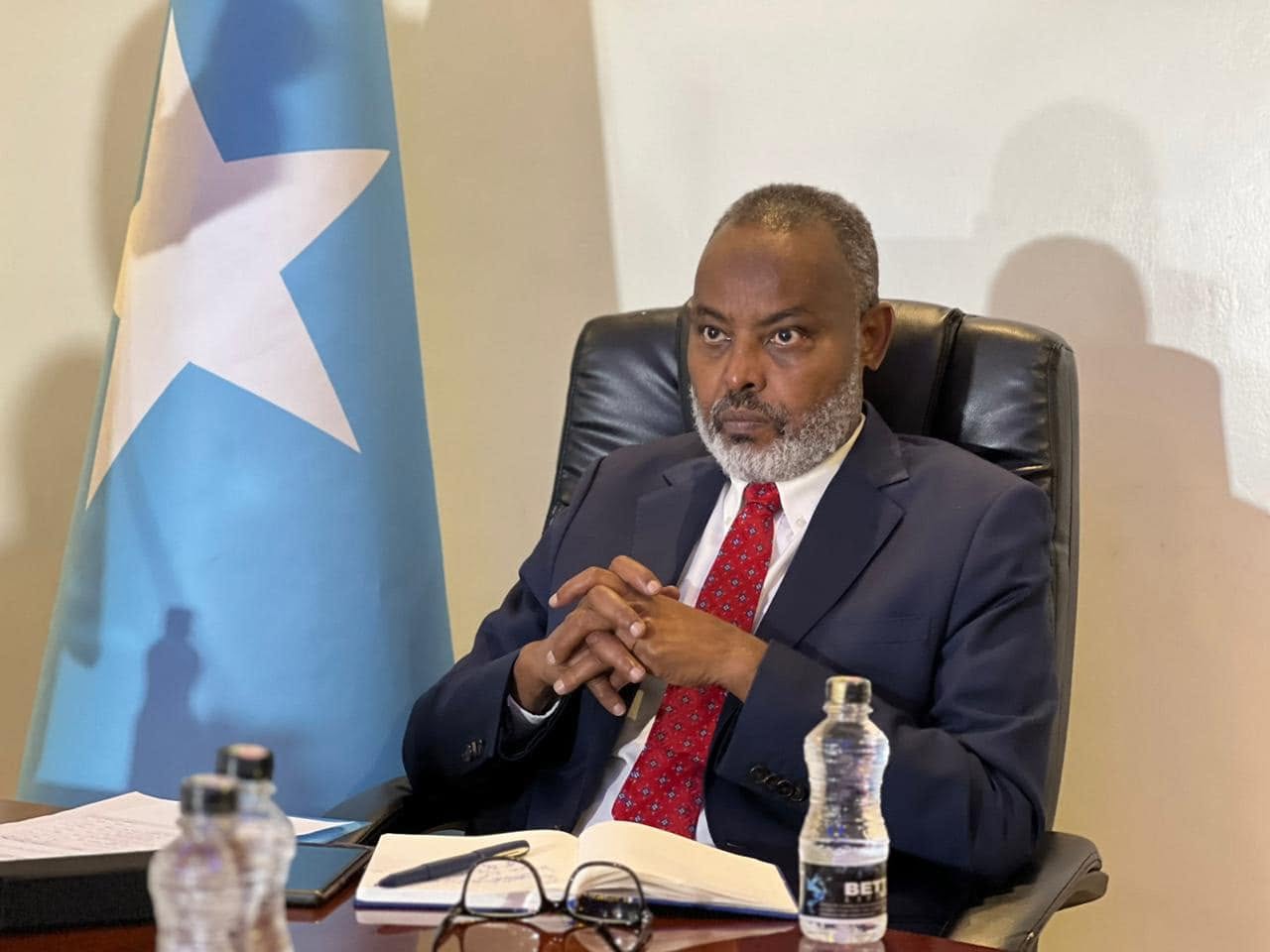
Mogadishu (Diplomat.so) – Former Somali Ambassador to Kenya and former Mogadishu mayor Amb. Mohamud Ahmed Nur "Tarsan" said in an interview with the privately owned Universal TV that Somaliland leader Abdirahman Mohamed Abdullahi (Irro) misled Israeli Prime Minister Benjamin Netanyahu by providing what Tarsan described as inaccurate information about Somaliland's population and political support in pursuit of international recognition.
Prime Minister Benjamin Netanyahu had previously reviewed intelligence assessments and recommendations prepared by Israel's Mossad concerning "Somaliland" before the illegal recognition decision. He said Abdirahman Irro later told the Israeli prime minister that Somaliland's population stood at six million people, a figure Tarsan rejected.
"Irro misled the Israeli prime minister. He told him his people number six million, but that is not true," Tarsan said during the interview.
Amb. Mohamud Ahmed Nur "Tarsan" said support for the unilateral independence of Somaliland separatists does not extend to all tribes living in the northern regions of Somalia. He identified the Samaron, Issa, Dhulbahante, Warsangeli, Faqashini and Gaboye clans as opposing secession. He also said some politicians, religious scholars and intellectuals from the Isaq clan support Somalia's unity and oppose engagement with Israel on the recognition issue.
He further said the Isaq community is not united on the question of secession, describing internal political divisions and differing views on relations with Israel.
Population estimates in political and academic discussions often place the Isaq clan at under one million people, although the absence of a modern and universally accepted census makes all demographic figures approximate. In these same accounts, the population is commonly described as being concentrated in three main urban centers: Hargeisa, Berbera, and Burao, which serve as key social and economic hubs.
The Somaliland economy is often described as being concentrated around a few key economic assets, particularly Berbera Port, Hargeisa Airport, and border crossings with Djibouti and Ethiopia. These routes form the backbone of import and export activity and are central to overall commercial performance. Livestock exports through Berbera are also linked to supply networks that extend beyond Somaliland’s internal production base, including sourcing from the Hiran and Bakool regions, which contributes to the scale and continuity of export volumes.
During the period of the British Somaliland Protectorate, colonial authorities entered into a series of informal understandings and agreements with various northern Somali clans regarding grazing rights, security arrangements, and administrative boundaries. These arrangements were primarily based on clan territories and traditional customary land use rather than clearly demarcated international borders. While they helped the British administration maintain indirect control over the interior through local elders and sultans, the agreements did not establish fixed inter-clan state borders in the modern legal sense.
"Recognition sought by one clan could encourage every other clan to declare its own separate state, creating political and security risks for Africa," Mohamud Tarsan said.
Tarsan also urged the Federal Government of Somalia to pursue both political and military measures in response to recent developments.
The Federal Government of Somalia has on two separate occasions formally urged Israel to reconsider and reverse its decision to recognize Somaliland, describing the move as lacking legal foundation and inconsistent with Somalia’s sovereignty framework.
Mogadishu maintains that the northwestern region remain an inseparable part of the Federal Republic of Somalia under both the national constitution and established principles of international law governing territorial integrity. Somali officials have further warned that external recognition of Somaliland could undermine ongoing efforts to preserve national unity, weaken regional stability, and increase the risk of unrest, with potential to escalate tensions and spread instability across both the Horn of Africa and wider East Africa region.