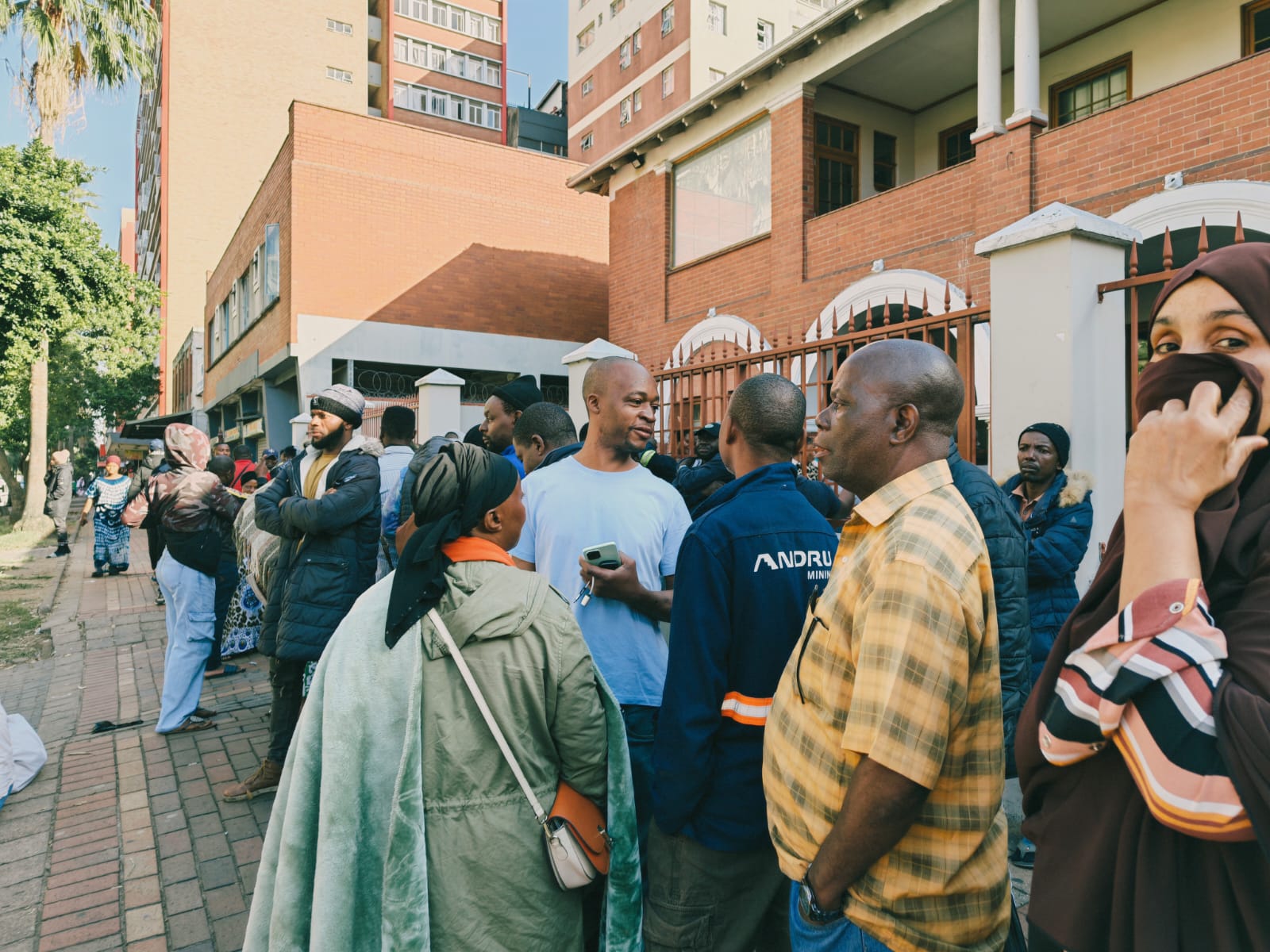
Durban (Diplomat.so) - South African police on Thursday removed about 400 foreign nationals from a church shelter in Durban after days of standoff tensions linked to anti-migrant demonstrations targeting undocumented foreigners in the coastal city.
Police escorted migrants from countries including the Democratic Republic of Congo, Somalia, Ethiopia, Rwanda, and Ghana onto buses headed to a government refugee facility after several days of uncertainty at the church complex in eastern Durban. The operation followed mounting pressure from local anti-immigrant campaigners who had demanded undocumented migrants leave nearby communities before June 30.
Outside the church compound, crowds gathered behind police barriers as officers supervised the evacuation under cloudy winter conditions. Some demonstrators chanted anti-immigration slogans as buses departed carrying women, children and elderly migrants. Several migrants pressed identity documents against bus windows, attempting to demonstrate their legal status in South Africa.
"There was fear and exhaustion among many of the families,” a humanitarian volunteer assisting displaced migrants told Diplomat News Network. "Some people said they had remained inside the church for days because they feared harassment or attacks in surrounding neighborhoods.”
Police maintained a heavy security presence around the church entrance after minor scuffles broke out during the evacuation. One man briefly broke through the security cordon before officers intervened to prevent further confrontation with residents gathered nearby.
Jacinta Ngobese-Zuma, leader of the anti-immigration group March and March, told reporters her movement opposed violence but wanted undocumented migrants removed from local communities. "Residents are frustrated about unemployment, crime and pressure on public services,” she said during a media briefing in Durban.
Migration analysts and civil society organizations rejected claims linking migrants directly to rising crime and economic hardship. Kagiso Thabo, a Johannesburg-based political analyst, said economic frustrations were increasingly being redirected toward foreign nationals ahead of local elections scheduled within the next six months. "Periods of political competition often intensify anti-immigrant rhetoric and deepen social divisions,” he said.
Members of the Somali community in South Africa urged authorities and local communities to recognize the longstanding contributions made by Somali migrants to the country’s economy and social fabric.
"Somali-owned businesses play an important role in many local economies by creating jobs and supplying essential goods in communities across the country,” said Muhiaddin Wardhere, a Somali community representative. "Most Somali families came to South Africa seeking safety and economic opportunity, and many have invested years rebuilding their lives through small-scale trade and entrepreneurship.”
Muhiaddin also highlighted historical ties between Somalia and South Africa during the anti-apartheid struggle. "There is a shared history between our peoples dating back to the apartheid period, when the Government of Somalia provided direct political and diplomatic support to South African anti-apartheid leaders and movements,” he said. "Somalia also supported activists through issuing passports, facilitating international travel, and providing financial assistance to members of the liberation struggle, including figures such as Oliver Reginald Kaizana Tambo and other prominent leaders.”
Community representatives added that Somali traders continue to operate in areas where formal economic services are limited, often serving both migrant and South African customers. They also called for greater protection of lawful migrants and refugees, stressing that recurring xenophobic incidents risk undermining social cohesion and local economic stability.
South Africa has experienced recurring outbreaks of xenophobic violence since 2008, when attacks against migrants killed dozens of people and displaced thousands. Similar unrest occurred in 2015 and 2021 amid rising unemployment and growing political tensions surrounding immigration.
Robert Ikobia, a migrant from the Democratic Republic of Congo who had sheltered at the church centre, said repeated waves of xenophobic violence had left many foreign nationals feeling unsafe despite holding legal documentation.
"I fled conflict in my country when I was young, but I continue facing violence here,” Ikobia said. "I have legal papers to stay in South Africa, yet every period of xenophobic unrest puts my life at risk again.”