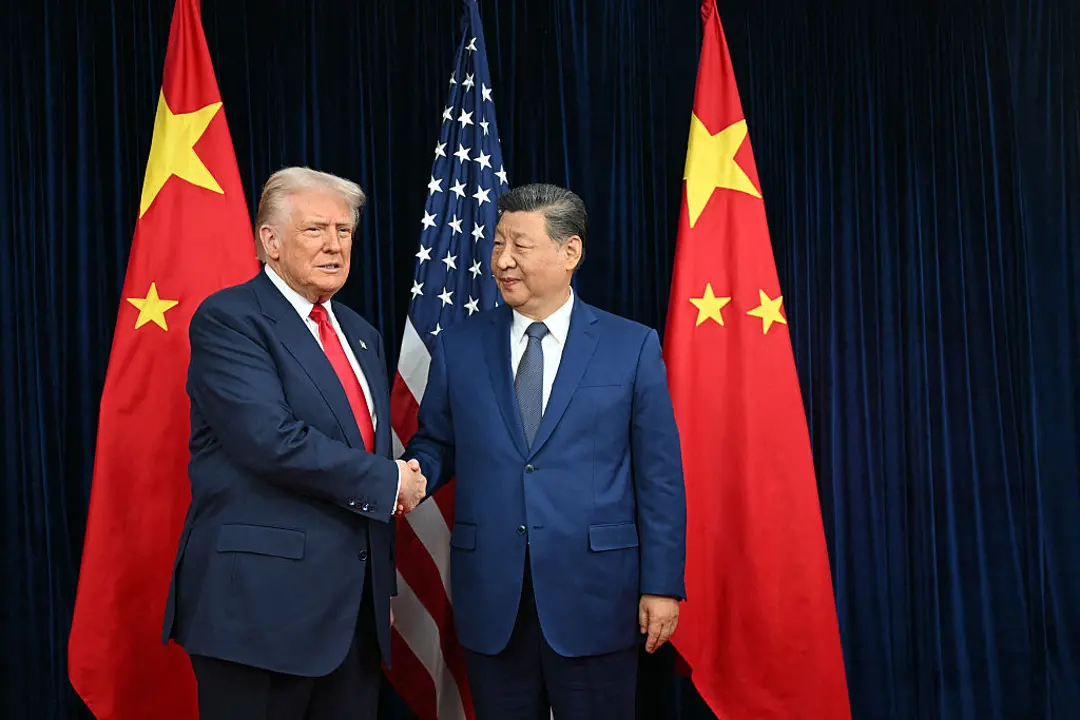
Beijing (Diplomat.so) – US President Donald Trump met Chinese President Xi Jinping in Beijing on Thursday, May 14, during high-level talks featuring tightened cybersecurity protocols and restricted communications for the American delegation.
Tight Cybersecurity Protocols for US Delegation
The American delegation accompanying President Donald Trump in Beijing operated under strict cybersecurity restrictions designed to reduce exposure to electronic surveillance risks during the visit. Officials confirmed that the team relied on pre-configured "clean” mobile devices, secured laptops, and controlled communication channels intended to limit access to personal data and routine digital services.
According to current and former US officials familiar with the arrangements, standard features such as cloud storage, personal messaging applications, and saved contact lists were disabled on official devices. Communications were routed through government-managed systems, with additional monitoring by security personnel responsible for protecting sensitive diplomatic exchanges.
A former US Secret Service official, Bill Gage, speaking on condition of attribution, said China is treated as a "mass surveillance environment” in security planning. He added that advance briefings consistently warn personnel that "everything may be subject to monitoring.”
Surveillance Risks
Security concerns surrounding electronic surveillance have shaped US diplomatic protocols in China for years, with heightened attention given to both state and non-state cyber capabilities. Officials traveling with the president are instructed to avoid reliance on local networks, including hotel Wi-Fi systems and public charging stations.
Teresa Payton, former White House Chief Information Officer and cybersecurity expert, said officials are trained to assume continuous observation risks. "They are instructed to operate under the assumption that all digital and physical communications could be monitored,” she said.
Cybersecurity specialists also caution against "juice jacking,” a method in which compromised USB ports can be used to extract data or install malicious software. As a result, the delegation uses government-issued charging equipment, portable batteries, and verified communication hardware brought from the United States.
Sensitive discussions are held in Secure Compartmented Information Facilities (SCIFs), temporary classified environments deployed in hotels or secured diplomatic venues. These rooms are designed to prevent electronic interception or audio surveillance during high-level meetings.
Formal Reception at the Great Hall of the People
The meeting between Trump and Xi took place at Beijing’s Great Hall of the People, where the Chinese government staged a formal reception featuring military honor guards, ceremonial music, and coordinated displays involving children waving both American and Chinese flags.
President Xi stated that "a stable relationship between China and the United States benefits the world,” adding that both countries "should be partners rather than adversaries.” President Trump described Xi as a "friend and great leader,” noting that bilateral differences "have always been manageable through dialogue and mutual respect.”
A senior White House official, speaking to Diplomat News Network, said the tone of the meeting remained "structured but constructive,” emphasizing that both sides prioritized maintaining open channels despite ongoing geopolitical tensions.
Economic Signaling
The summit was attended by several prominent business leaders, including Elon Musk, Nvidia CEO Jensen Huang, and outgoing Apple CEO Tim Cook. Their presence underscored the strategic importance of US-China economic ties, particularly in the technology and semiconductor sectors.
Industry observers noted that access to the Chinese market remains essential for major US technology firms, especially as global competition intensifies over advanced chip manufacturing and artificial intelligence infrastructure. Nvidia’s engagement in China, in particular, reflects ongoing commercial interest in expanding semiconductor sales despite export restrictions and regulatory scrutiny.
Strait of Hormuz
Beyond economic discussions, the talks were shaped by wider regional security concerns, including tensions involving Iran and maritime stability in the Strait of Hormuz. President Trump described the current ceasefire between Washington and Tehran as being "on life support,” reflecting ongoing uncertainty in the region.
US Secretary of State Marco Rubio stated that Washington had made clear to Beijing that "any support for Iran would damage bilateral relations,” while urging China to contribute more actively to de-escalation efforts in the Middle East.
China remains a major importer of Iranian oil, making it highly sensitive to disruptions in energy flows through the Gulf. Analysts note that instability in the Strait of Hormuz would have immediate consequences for global energy prices and supply chains.
Taiwan
Taiwan also featured prominently in the broader context of US-China relations. Beijing continues to assert its claim over the self-governed island and has not ruled out the use of force to achieve reunification. The United States maintains a policy of strategic ambiguity while continuing to supply defensive military assistance to Taipei.
Security analysts warn that Taiwan’s role as a global hub for advanced semiconductor production adds a critical economic dimension to the geopolitical dispute. Any escalation involving the island could significantly disrupt global technology supply chains.
Regional observers in Taipei expressed concern that long-term US-China negotiations could influence Washington’s strategic commitments, particularly if broader economic or diplomatic trade-offs emerge between the two powers.
Strategic Outlook
The Beijing summit highlighted the growing intersection of cybersecurity, geopolitical rivalry, and economic interdependence shaping US-China relations. Both leaders emphasized the importance of maintaining dialogue, even as underlying tensions persist across technology security, regional conflicts, and strategic influence.
The tightly controlled digital environment surrounding the US delegation reflects broader shifts in diplomatic practice, where cybersecurity considerations now play a central role in international engagement. Analysts note that such measures underscore the depth of mistrust between the world’s two largest economies, even amid efforts to stabilize relations through high-level dialogue.