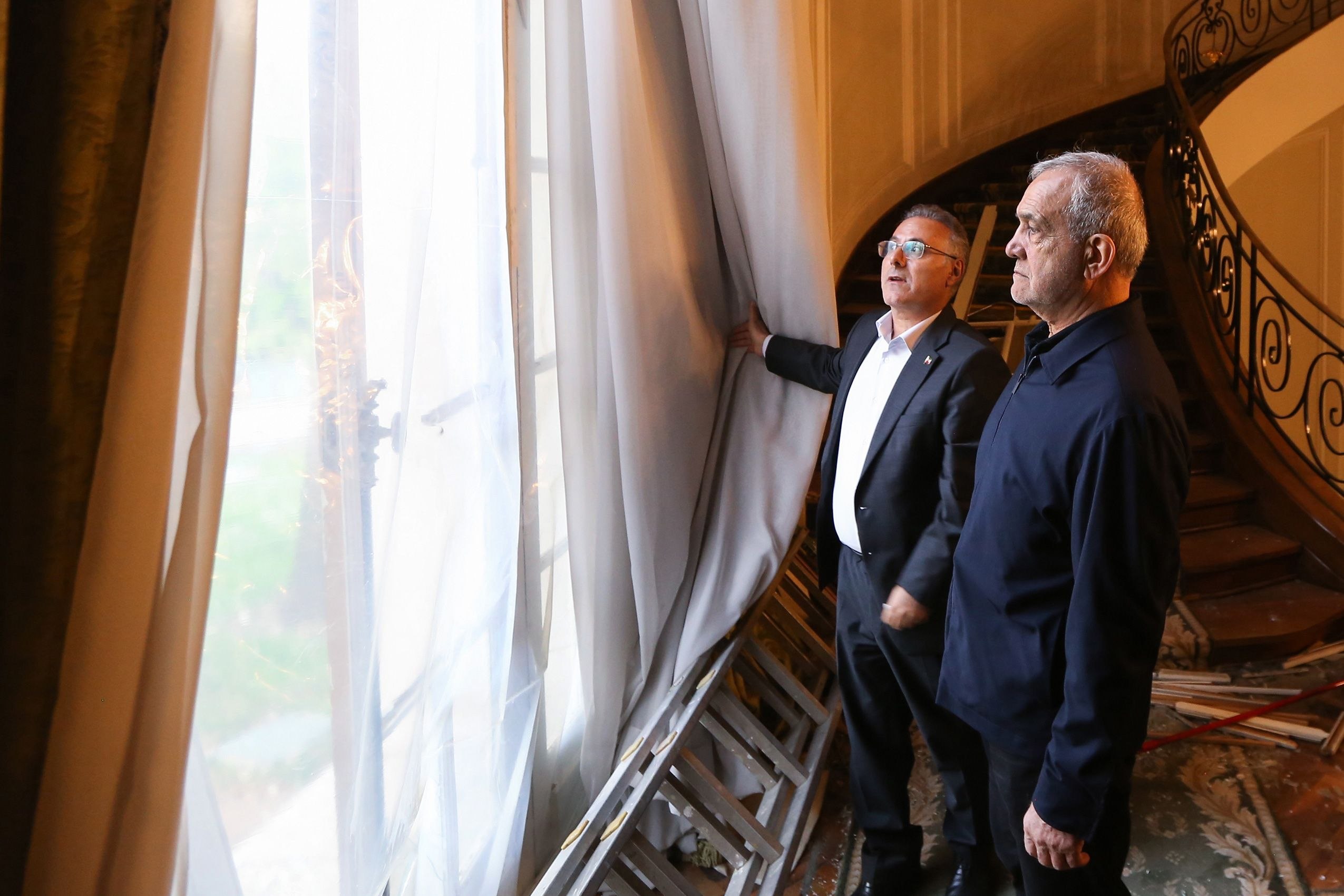
Tehran (Diplomat.so) - Iranian authorities on Friday inspected cultural sites, universities, and residential neighborhoods damaged since the United States and Israel launched military strikes against Iran on February 28, as Washington confirmed new attacks targeting Iranian military infrastructure near the Strait of Hormuz.
Iranian President Masoud Pezeshkian visited the Saad Abad cultural-historical complex in northern Tehran to assess destruction caused during the conflict, according to Iranian officials and state-affiliated media. The visit formed part of a wider government review of damage to civilian infrastructure, historical monuments, and academic institutions following months of hostilities involving U.S. and Israeli warplanes, drones, naval forces, and missile systems.
The conflict began on February 28 when the United States and Israel carried out coordinated strikes on Iranian military facilities, air defense systems, missile sites, and strategic infrastructure, according to official statements issued by Washington and Tel Aviv at the time. Iranian authorities have since reported repeated attacks on military and civilian targets across several provinces.
On Friday, the U.S. military said it launched additional retaliatory strikes after Iranian forces allegedly approached American naval vessels transiting the Strait of Hormuz with missiles, drones, and small attack boats. U.S. Central Command stated that American forces targeted Iranian missile launch facilities, drone infrastructure, command centers, and intelligence positions linked to attacks on U.S. assets.
The U.S. military said no American personnel or vessels were damaged during the confrontation and added that its forces remained prepared to defend American interests in the region.
Iranian media reported explosions near Bandar Abbas, Minab, and other coastal areas overlooking the Gulf late Thursday and early Friday. State-affiliated outlets also said air defense systems were activated in Tehran following reports of aerial activity and explosions in southern Iran.
Cultural Sites and Civilian Infrastructure Damaged
During his inspection at Saad Abad Palace, President Pezeshkian toured damaged sections of the historical complex alongside cultural heritage officials and engineers overseeing emergency assessments. Cracked walls, shattered windows, and debris remained visible in parts of the compound as restoration teams documented structural damage.
Iranian Minister of Cultural Heritage and Tourism Reza Salehi Amiri said authorities identified 149 historical buildings and cultural sites requiring restoration after the recent attacks.
"With the campaign created at the national and international level, we are seeking to restore these buildings with the efforts of Iranians inside and outside the country,” Salehi Amiri said in remarks published by Iranian media. He added that debris removal and technical studies were underway before full restoration operations begin.
A cultural preservation employee working at the Saad Abad complex told Diplomat News Network that security measures around the palace had intensified following the attacks.
"Specialists are examining each damaged section carefully because some structures are historically sensitive,” the employee said. "The goal is to preserve as much of the original architecture as possible.”
Universities and Housing Reconstruction Efforts
Iran’s Ministry of Science also confirmed significant damage to university facilities, particularly at Sharif University of Technology in Tehran. Science Minister Hossein Simaei said reconstruction work had started but warned that the scale of destruction would require major financial support.
"The reconstruction of universities destroyed in the war, especially Sharif University, has started,” Simaei said Friday. "It requires extensive resources, and we hope conditions will soon improve.”
Simaei also stated that authorities had not yet decided whether upcoming university entrance examinations would be conducted in person, citing uncertainty surrounding the security situation.
At the same time, Iran’s Endowment and Charity Affairs Organization announced expanded humanitarian operations to support civilians affected by the conflict. Officials said assistance programs included rebuilding homes destroyed or damaged during the fighting and supporting displaced families.
In several districts of southern Tehran, municipal workers and engineering teams inspected apartment buildings and utility infrastructure damaged by explosions. Residents gathered near damaged structures Friday morning as aid workers distributed emergency supplies and documented repair needs.
"We are trying to continue our lives despite the destruction,” said Tehran resident Fatemeh Rahimi, whose residential block suffered blast damage during recent strikes. "People remain concerned because the situation is still unstable.”
Regional Tensions
The latest military exchanges have intensified concerns about broader instability across the Gulf region and the possibility of further escalation involving Iran, the United States, and Israel.
U.S. President Donald Trump said earlier this week that a diplomatic agreement with Iran remained possible despite continuing military confrontations. Trump stated that Washington’s primary objective remained preventing Iran from obtaining nuclear weapons and suggested negotiations were continuing through indirect channels.
Security analysts say the ongoing conflict has disrupted shipping activity, aviation routes, and regional energy markets, particularly around the Strait of Hormuz, one of the world’s most strategically important maritime corridors for oil transportation.
Diplomatic observers also note that both Tehran and Washington appear to be combining military pressure with efforts to avoid a wider regional conflict. Despite ongoing discussions about possible ceasefire arrangements, repeated missile exchanges, drone attacks, naval confrontations, and air strikes indicate that tensions across the Gulf remain highly volatile.