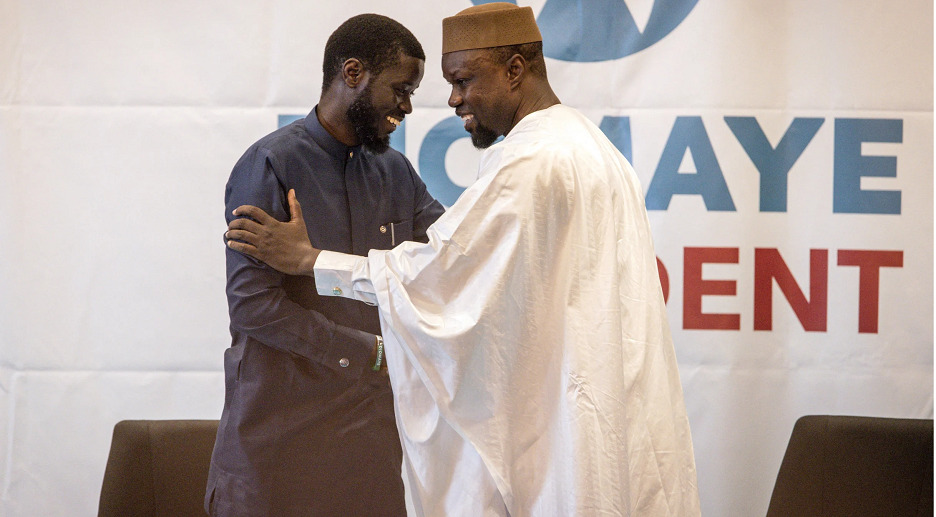
Dakar (Diplomat.so) – Senegalese President Bassirou Diomaye Faye, in a televised address aired on state television on Saturday, May 2, warned that the ruling Pastef party co-founded with Prime Minister Ousmane Sonko risks political collapse if it drifts from its founding principles while tensions between the two leaders intensify.
Rising political tensions within Pastef
Senegalese President Bassirou Diomaye Faye said the ruling party he leads with Prime Minister Ousmane Sonko could face a downward trajectory if internal disagreements are not addressed, signaling deepening strains within the country’s top leadership.
Faye stated during the broadcast that the party’s public support was rooted in its ideals rather than individual leadership ambitions. "If Pastef’s supporters do not change course, the party risks collapsing,” Faye said.
He added that his relationship with Sonko as prime minister remains conditional on performance, stressing executive authority within the presidency. "As long as (Sonko) remains prime minister, it’s because he is doing his job properly, and I am satisfied with that,” Faye said. "The day I am no longer satisfied, I will put Senegal’s interests first.”
The remarks were delivered in a controlled television studio setting in Dakar, where state broadcasters aired the interview with minimal audience presence, a format commonly used for official presidential communications.
Sonko’s role and political recalibration
Ousmane Sonko, once a leading opposition figure under the previous administration, was barred from the 2024 presidential election following a legal conviction. He subsequently endorsed Faye, his long-time political ally and Pastef member, as the party’s candidate, paving the way for Faye’s victory and Sonko’s appointment as prime minister.
Tensions between the two leaders have become increasingly visible since their transition into government. In March, Sonko publicly suggested he could withdraw Pastef from government participation if the administration diverged from its ideological direction.
A senior government official, speaking on condition of attribution, said internal disagreements were "not unusual in young administrations but require careful political management to avoid institutional instability.”
A Dakar-based political analyst told Diplomat News Network that "the current friction reflects unresolved questions about authority sharing between the presidency and the prime minister’s office, particularly in a party-driven government structure.”
Economic pressures
The political tensions come as Senegal faces mounting economic pressure following the International Monetary Fund’s suspension of its $1.8 billion programme in 2024 after the discovery of previously unreported public debt.
Negotiations for a new financial framework have shown limited progress. Sonko stated in November that Senegal would not accept IMF-proposed debt restructuring terms, further complicating discussions.
A trader in Dakar’s central market described growing uncertainty. "Prices are changing too quickly. People feel the pressure every week,” the trader said, pointing to fluctuating fuel costs and transport fares.
Faye noted that Senegal’s economy is operating without IMF support, though external shocks are affecting projections. "We had projected our growth based on an oil price of $64.5 per barrel. When the price rises to $119 per barrel, our growth forecasts are revised downward,” he said.
He added that increased energy costs are diverting state resources away from planned infrastructure investment and toward fuel imports, delaying development programmes.
External shocks and regional implications
Faye also referenced the impact of the Iran conflict on global energy markets, highlighting how rising oil prices are reshaping fiscal planning. Higher import costs are increasing pressure on public finances already constrained by debt revisions and financing gaps.
An energy policy expert in West Africa, speaking anonymously, said rising volatility in global oil markets is "amplifying structural vulnerabilities in import-dependent economies like Senegal, particularly those undergoing fiscal reform.”
Political background and institutional stakes
Pastef, the ruling party, rose to prominence on an anti-establishment platform advocating governance reform, economic sovereignty, and institutional transparency. The partnership between Faye and Sonko has been central to its political rise, with both figures shaping its ideological direction.
However, analysts note that dual leadership structures often generate internal friction, particularly in systems where executive authority overlaps between president and prime minister.
Governance implications and outlook
The emerging divide between Faye and Sonko places Senegal’s political stability under increased scrutiny at a time of economic uncertainty. Observers suggest that continued disagreement could affect policy continuity, investor confidence, and ongoing negotiations with international lenders.
A civil society representative in Dakar said public expectations remain focused on governance delivery. "People want stability, jobs, and predictable policies,” the representative said.
The evolving dynamic within Pastef underscores the broader challenge of balancing ideological cohesion with executive governance responsibilities. The trajectory of the Faye–Sonko relationship is expected to shape both political alignment within the ruling party and Senegal’s economic policy direction in the months ahead.