


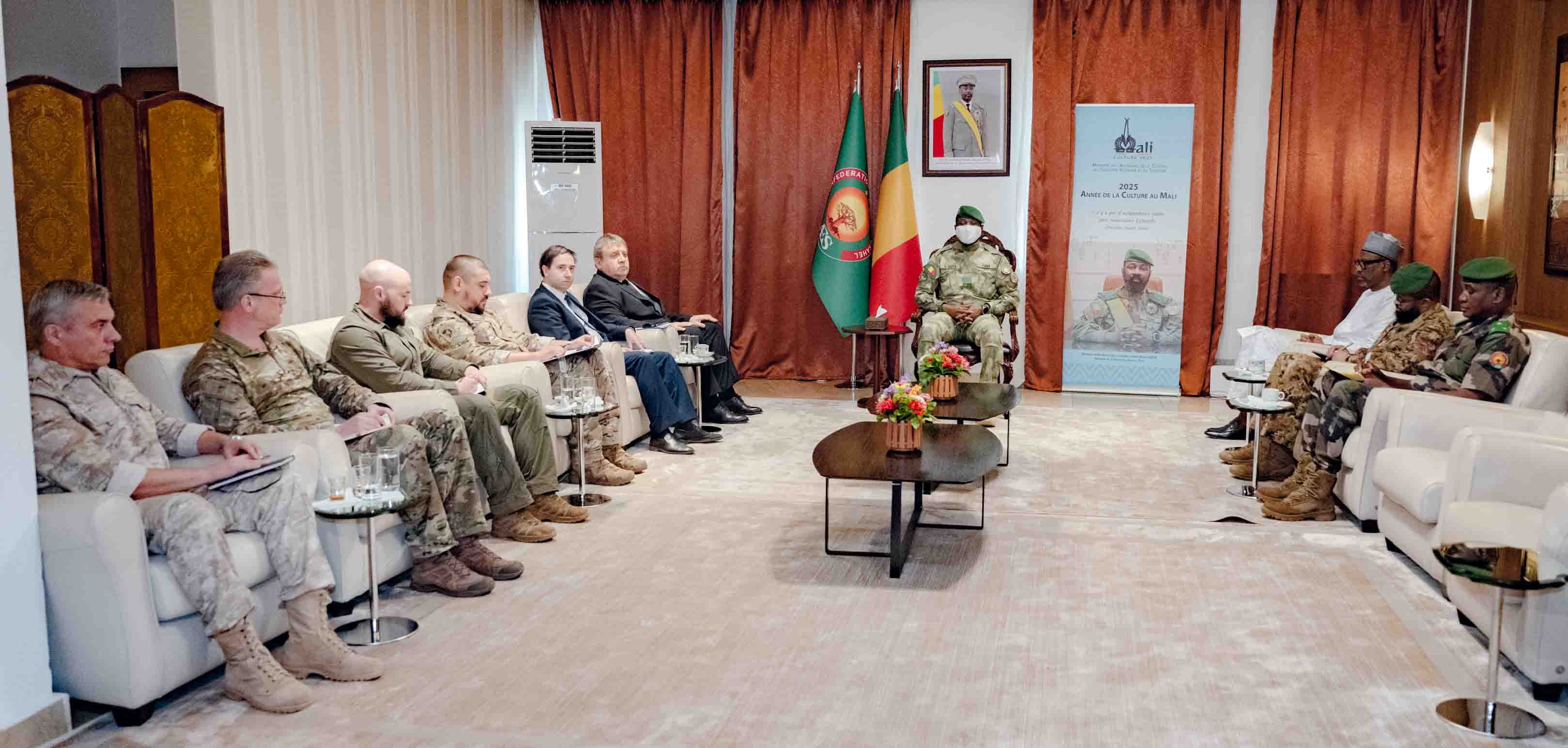
Bamako (Diplomat.so) – Mali's interim president, Assimi Goïta, met Russia's ambassador and a visiting delegation in Bamako on Tuesday, April 28, marking his first public appearance since coordinated armed attacks struck military positions across the country over the weekend.
The meeting, held at the presidential offices under heightened security, comes after days of uncertainty surrounding Goita’s whereabouts following the largest wave of coordinated assaults in Mali in nearly 15 years. The attacks, launched early Saturday, targeted key military installations in and around Bamako, as well as northern and central regions, prompting clashes that continued into the week.
Officials present at the meeting described it as a reaffirmation of Mali’s strategic partnership with Russia. A senior Malian government adviser, who refused to reveal his name, speaking to Diplomat News Network, said the talks focused on "security cooperation, stabilization efforts, and immediate responses to the evolving threat landscape.”
"The transitional president is actively engaged in overseeing national defense priorities,” the adviser said. "This meeting demonstrates continuity in leadership at a critical moment.”
Security Situation Remains Volatile
The Malian Armed Forces reported ongoing confrontations with what they described as "terrorist groups” across multiple regions, including near Bamako’s outskirts and strategic northern towns. Explosions were reported late Monday near Senou International Airport, with security forces reinforcing checkpoints and restricting movement in several districts.
Eyewitnesses in Bamako described a tense atmosphere, with reduced civilian movement and visible military patrols throughout the capital. "We heard loud blasts near the airport area,” said Kadidia Sékou, a shopkeeper in the Senou district. "People are staying indoors, and there are soldiers on every corner.”
At least 16 individuals were reported injured in the coordinated attacks, although the full casualty toll remains unclear. Among the most significant losses was Defense Minister Sadio Camara, who was killed alongside members of his family during the initial wave of violence, according to military sources.
The scale and coordination of the attacks have raised alarm among regional observers, as armed groups advanced into key northern cities, including Kidal, Gao, and Sevare, often encountering limited resistance. Videos circulating locally showed armed fighters moving in convoys of motorcycles across urban areas.
Armed Groups and Strategic Alliances
Responsibility for the assaults has been claimed by Jama’at Nusrat al-Islam wal-Muslimin (JNIM), an al-Qaeda-linked group, alongside the Azawad Liberation Front (FLA), a coalition of Tuareg separatist factions seeking autonomy in northern Mali.
Analysts note that the collaboration between jihadist groups and separatist movements marks a significant shift in the conflict dynamics. "This is the first time we are seeing such a coordinated operational alignment between these actors,” said Ramata Abdoulaye, a West Africa analyst, in remarks during a televised interview.
Ramata noted that while the armed groups have demonstrated an ability to launch large-scale attacks, they are unlikely to sustain control over major urban centers such as Bamako. "The capital is not currently under threat of being captured,” she said, adding that "the long-term security outlook remains concerning.”
Russian state representatives acknowledged the complexity of the situation. Kremlin spokesperson Dmitry Peskov stated that restoring stability in Mali is a priority, emphasizing Moscow’s continued support for the Malian government.
Russian Involvement and Military Dynamics
Russia’s Africa Corps, a paramilitary force that replaced the Wagner Group in Mali, has been actively supporting Malian forces in counterinsurgency operations. Russian sources indicated that their personnel were involved in repelling attempts by armed groups to seize strategic sites, including areas near the presidential palace.
However, the group reportedly withdrew from the northern town of Kidal following intense fighting, which has since fallen under the control of armed factions. Russian officials acknowledged casualties but did not provide specific figures.
A security analyst based in Dakar, speaking on condition of attribution due to the sensitivity of the situation, told Diplomat News Network that "the withdrawal from Kidal reflects both tactical recalibration and the growing operational challenges faced by Malian and allied forces in the north.”
Historical Context and Conflict Drivers
Mali has faced persistent instability for over a decade, driven by a combination of jihadist insurgency and longstanding separatist tensions in the north. The roots of the Tuareg independence movement date back to the early 20th century, intensifying after Mali’s independence in 1960.
Repeated rebellions, including the 2012 civil war, led to the temporary declaration of an independent Azawad state in the north. Although a peace agreement was signed in 2015, implementation remained fragile, and violence continued intermittently.
The formation of JNIM in 2017 consolidated several jihadist factions operating across the Sahel, expanding their reach and operational capacity. The group currently maintains an estimated force of thousands of fighters across Mali, Niger, and Burkina Faso.
Recent developments, including the dissolution of the Algiers peace agreement in early 2024 and renewed military offensives by the Malian government, have further escalated tensions. The emergence of the Azawad Liberation Front as a unified separatist entity has added another layer of complexity to the conflict.
Mali is ethnically diverse, with the Bambara forming the largest group and concentrated primarily in the central and southern regions, including the capital Bamako. In the north, Tuareg and Arab communities are more prevalent, with strong cultural and historical ties extending across borders into Algeria, Niger, and Mauritania. These northern groups have long expressed grievances over political marginalization, economic neglect, and limited state presence, factors that have contributed to recurring separatist movements and periodic armed rebellions. The interplay between ethnic identity, regional inequality, and governance challenges continues to shape the dynamics of Mali’s internal conflict.
Civilian Impact and Regional Implications
The ongoing violence has had significant humanitarian consequences. Thousands of civilians have been displaced in recent months, particularly in northern regions where control frequently shifts between armed actors.
Local residents described disruptions to daily life, including shortages of essential goods and limited access to healthcare. "We are afraid to travel between towns,” said Abdoulaye Ag Mohamed, a resident of Gao. "There are checkpoints everywhere, and no one knows who controls the roads.”
Regional governments are closely monitoring the situation, given the potential for cross-border instability. Mali’s relations with neighboring countries have been strained by accusations of external support for rebel groups, which have been denied by the governments concerned.
Several countries have rejected allegations of involvement in Mali’s ongoing conflict after claims emerged suggesting external backing for armed groups operating in the north. Ukraine denied any role in providing support to rebel factions following accusations linked to a previous ambush in Tinzaouaten, while Algeria dismissed claims that it was sheltering separatist leaders, maintaining that it respects Mali’s sovereignty. France has also repeatedly rejected assertions that it facilitates rebel coordination abroad, and Mauritania has denied allegations that it provides safe haven to armed groups, stressing its continued commitment to managing border security and hosting displaced civilians from Mali.
The presence of foreign military actors, including Russian forces, has also reshaped geopolitical dynamics in the Sahel, particularly following the withdrawal of French troops and United Nations peacekeepers in recent years.
Strategic and Political Implications
Goita’s reappearance is likely intended to project stability and continuity in leadership amid growing domestic and international scrutiny. His absence in the immediate aftermath of the attacks had fueled speculation about internal divisions within the military-led government.
Political analysts suggest that maintaining public confidence will be critical as the junta navigates both security challenges and diplomatic pressures. "Visibility of leadership during crises is essential,” said Fatoumata Diallo, a political analyst based in Bamako. "This appearance signals that the government remains in control, but the underlying challenges are far from resolved.”
The alliance between insurgent and separatist groups presents a significant strategic threat, potentially prolonging the conflict and complicating efforts to reach a negotiated settlement.
Goïta Promoted Himself to Junta General
Assimi Goïta, Mali’s transitional president and head of state, has consolidated his position within the country’s military junta and armed forces leadership after promoting himself in October 2024 from colonel to the rank of 5-star army general, making him the highest-ranking officer in the Malian Armed Forces.
Goïta first seized power on August 18, 2020, when he led a military coup as a colonel that overthrew the civilian government, establishing a military junta that later formalized a transitional administration under his leadership. He subsequently strengthened his control over the state after a second power shift in May 2021, which removed the interim civilian leadership and positioned him as head of the transition.
His 2024 promotion further reinforced his dual role as both leader of the junta and the country’s top military authority during an ongoing period of political transition and security instability.
Outlook
Mali’s security environment remains fluid, with ongoing clashes and shifting territorial control underscoring the fragility of the current situation. The government’s reliance on foreign military support, combined with internal political pressures, will shape its response in the coming weeks.
Observers note that any durable resolution will likely require a combination of military, political, and economic measures addressing the root causes of the conflict, including regional disparities and governance challenges.
For now, the reemergence of General Assimi Goita provides a visible focal point for the state’s response, as Mali confronts one of the most significant security crises in its recent history.
Leave a comment