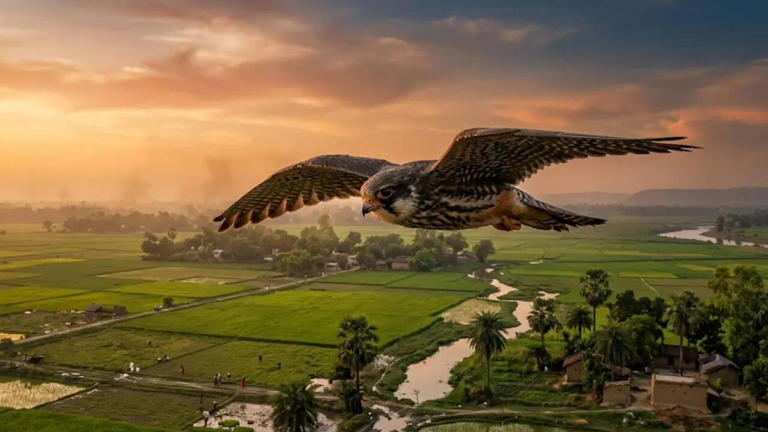
Gaya (Diplomat.so) – The Wildlife Institute of India confirmed that an Amur Falcon named Apapang completed a 4,750-kilometre nonstop migration from Somalia to India's Gaya-Rohtas landscape in 95 hours on Monday, May 5.
Researchers tracking the bird said the journey, monitored through a solar-powered satellite transmitter, represents one of the longest continuous overwater flights recorded for a raptor of its size. Weighing roughly 150 grams, about the same as a smartphone, the Amur Falcon (Falco amurensis) relies on precise timing, favorable winds, and energy-efficient flight strategies to complete the crossing over the Arabian Sea.
"This is a remarkable demonstration of endurance and navigation,” said Sunil Ramesh, an Indian senior ornithologist, speaking to Diplomat News Network. "Apapang’s uninterrupted 95-hour flight highlights how these birds optimize wind systems and metabolic reserves to sustain extreme journeys, showcasing the remarkable resilience of migratory raptors across continents.”
Satellite Tracking
The bird’s journey was recorded using a 5-gram solar-powered Platform Transmitter Terminal (PTT) tag, allowing conservationists to monitor its route in near real time. Data showed that Apapang departed from the Horn of Africa, likely from central Somalia, before crossing vast stretches of open ocean without stopping.
Field researchers in Bihar reported increased monitoring activity as the falcon approached the Gaya-Rohtas landscape, a region known for hosting migratory birds during seasonal transitions. "We observed heightened bird movement patterns over the past 48 hours, coinciding with favorable wind currents,” said Anil Prasad, a local forest officer stationed in Gaya district.
Local residents in rural Rohtas described seeing small flocks of fast-moving birds at high altitude during early morning hours. "They were barely visible, just shadows moving quickly across the sky,” said Suresh Prakash, a farmer in the region. "We’ve seen them before, but never thought they came from so far away.”
Biological Adaptations for Long-Distance Flight
Scientific studies published by the Society for Conservation Biology indicate that Amur Falcons possess specialized metabolic adaptations that allow them to sustain prolonged flight. These include efficient fat storage and energy conversion mechanisms that enable continuous movement without feeding.
The migration is also closely synchronized with the presence of dragonflies, particularly wandering gliders, which provide a protein-rich food source before departure. "Their timing is not accidental,” explained Kavita Devendra , an avian ecologist based in New Delhi. "They build up energy reserves by feeding intensively before embarking on the ocean crossing.”
Researchers say the falcons exploit strong tailwinds at higher altitudes, reducing energy expenditure and enabling faster travel across long distances.
Conservation Framework
The Amur Falcon’s migration spans multiple countries, placing it under the protection of the Convention on Migratory Species (CMS), an international treaty focused on conserving migratory wildlife. India, a signatory, has implemented measures to protect critical stopover habitats, particularly in northeastern states such as Nagaland and Manipur, as well as parts of Bihar.
The Gaya-Rohtas landscape, where Apapang arrived, has gained attention for its ecological and cultural significance. The region, encompassing parts of southern Bihar, has been proposed as a UNESCO World Heritage Site due to its rich biodiversity and archaeological heritage.
Forest officials noted that anti-poaching awareness campaigns in recent years have reduced threats to migratory birds in the region. "Community engagement has been key,” said Prasad. "Local populations are increasingly aware of the importance of protecting these species.”
Climate Pressures
Scientists caution that the success of such long-distance migrations depends heavily on stable climate patterns, particularly monsoon wind systems. Changes in wind direction or intensity could significantly increase the energy demands of the journey.
"Even slight disruptions in wind patterns can alter migration efficiency,” said Sunil Ramesh. "If climate variability intensifies, birds like Apapang may face higher mortality risks during these crossings.”
Recent avian research suggests that shifts in atmospheric conditions linked to climate change could force migratory species to adjust routes, timing, or stopover points, potentially affecting survival rates.
Broader Significance of the Journey
Apapang’s journey forms part of the Amur Falcon’s annual migration cycle, which spans approximately 22,000 kilometres between breeding grounds in East Asia and wintering regions in southern Africa.
Conservationists say tracking individual birds provides critical data for understanding migration corridors and identifying emerging threats. "Each tracked bird contributes to a larger picture,” Kavita Devendra said. "It helps us design better conservation strategies across international borders.”
The successful arrival of Apapang underscores both the resilience of migratory species and the growing importance of coordinated conservation efforts across continents.