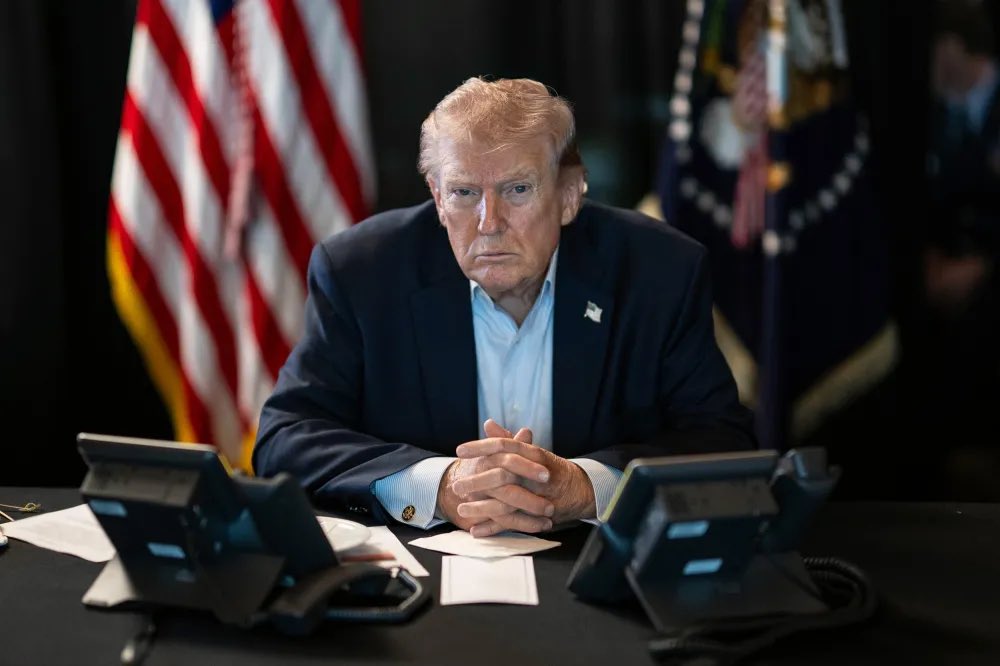
Washington, D.C. (Diplomat.so) – US President Donald Trumo said on Sunday, in Washington, D.C., that a US delegation will travel to Islamabad, Pakistan, to continue negotiations with Iran, amid rising regional tensions and reported maritime incidents in the Strait of Hormuz.
US Diplomatic Channel
Trump stated that American representatives are expected to arrive in Islamabad by Monday to advance discussions with Iranian counterparts, describing the effort as part of an ongoing push toward a negotiated settlement.
"Our representatives will go to Islamabad and will be there by Monday for negotiations,” Trumo said, adding that Washington has already presented what he described as a "fair and reasonable” proposal to Tehran.
He further stressed that a diplomatic outcome remains possible but not guaranteed. "A peace agreement with Iran will happen, either in a friendly way or in an unfriendly way,” he said, signaling both openness to diplomacy and willingness to escalate pressure if talks fail.
The US administration has not publicly released details of the proposed framework, but President Trump indicated that the initiative is aimed at preventing further deterioration of regional stability.
Maritime Security Tensions
Trump also referred to recent developments in the Strait of Hormuz, alleging that Iranian forces fired on vessels over the weekend, including ships identified as French and British. He characterized the incidents as a breach of ceasefire understandings.
"They fired in the Strait of Hormuz, which is a complete violation of the ceasefire agreement,” he said.
The Strait of Hormuz remains one of the world’s most strategically significant maritime corridors, with a substantial share of global oil shipments passing through it. Any disruption in the area typically raises concerns over energy security and global price stability.
Trump also commented on Iran’s reported statements regarding the closure of the strait, calling the announcement "surprising,” while arguing that external pressure had already restricted its operational capacity. He further claimed that Iran is losing approximately $500 million daily due to disrupted energy flows and trade constraints.
Turkish Diplomatic Engagement
In parallel diplomatic developments, Turkish Foreign Minister Hakan Fidan said Iran and the United States both appear willing to continue negotiations aimed at preventing renewed conflict.
Speaking at a diplomatic forum in Antalya, Fidan noted that while discussions have progressed, significant differences remain between the parties.
"On the whole, Iran and the United States want to continue talks to end the war,” Fidan said, adding that "there are still several disagreements despite substantial progress.”
He emphasized concern over the expiration of the current ceasefire framework, warning that regional actors are closely monitoring developments. "No one wants to see a new war erupt when the ceasefire expires next week. We hope the parties extend it,” he added.
Fidan expressed cautious optimism about diplomatic continuity, stating, "I am hopeful that it will be extended.”
Netanyahu Defends Israeli Military Operations
Israeli Prime Minister Benjamin Netanyahu also addressed regional security developments, defending recent military operations against Iran, including "Operation Rising Lion” and "Operation Roaring Lion.”
He said the operations were critical in preventing Iran from acquiring nuclear weapons capability, describing them as necessary for national survival.
"We faced a tremendous test this year. It became clear that Iran was working to prepare nuclear bombs to destroy us,” Netanyahu said.
He added that failure to act would have had severe consequences. "If we had not acted, Iran would now have nuclear bombs, which would mark the beginning of the end for the Jewish people,” he stated.
Netanyahu further argued that Israel’s actions have reshaped regional dynamics, saying the country has "changed the Middle East and also changed itself through actions no other state would normally undertake.”
Regional Stakes and Diplomatic Uncertainty
Diplomatic observers note that simultaneous signals of negotiation and escalation reflect a fragile strategic environment involving multiple actors with competing security priorities.
A regional analyst cited in Diplomat News Network said the current phase represents "a high-risk balance between diplomacy and deterrence, where each side is testing the limits of pressure without fully abandoning negotiations.”
The Strait of Hormuz continues to function as a critical pressure point in global energy security, while the overlapping diplomatic tracks involving the United States, Iran, Türkiye, and Israel highlight the complexity of managing escalation risks.
With ceasefire timelines approaching and negotiations shifting between public signaling and backchannel diplomacy, the coming days are expected to play a decisive role in determining whether the situation moves toward de-escalation or further confrontation.