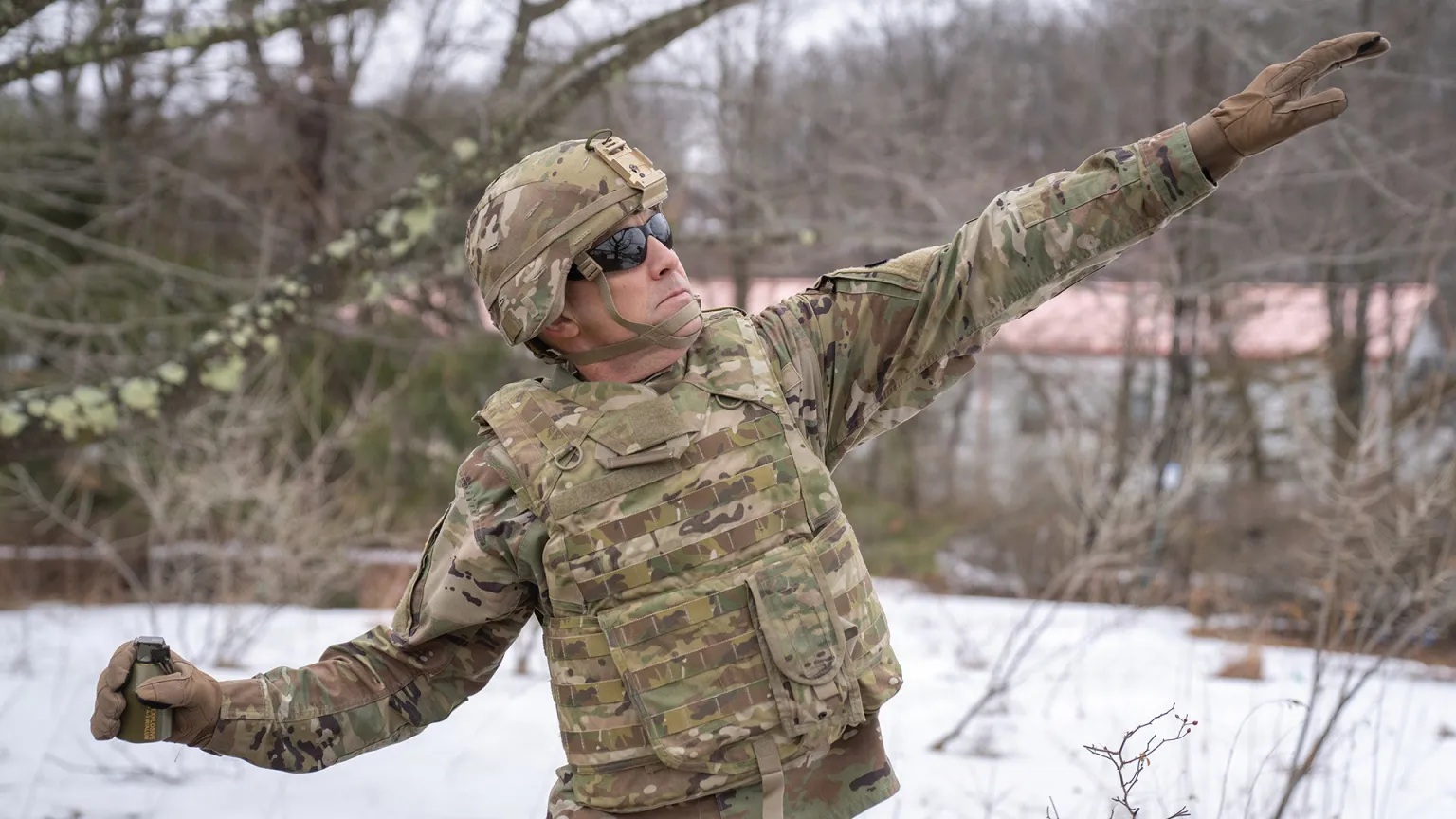
Washington, D.C. (Diplomat.so) – The U.S. Army announced on this week, the deployment of the M111 grenade, a new urban-focused explosive designed to replace traditional shrapnel-based devices in close-quarters operations.
The M111 grenade, developed by the Army’s Ordnance and Armament Division, relies on blast overpressure (BOP) waves rather than conventional metal fragments, offering a tactical solution for confined environments. Lieutenant Colonel Jason Whitaker, speaking at a Pentagon briefing, explained that the weapon "minimizes collateral damage while allowing soldiers to neutralize threats inside buildings without unnecessary exposure.”
During a controlled demonstration at Fort Bragg, North Carolina, observers reported the grenade’s shockwave dispersing throughout multiple enclosed rooms, effectively disabling target dummies without scattering hazardous fragments.
Medical analysts noted that blast overpressure affects the human body internally, potentially causing eardrum rupture, lung trauma, or brain injuries. Unlike traditional grenades, such as the M67, which produce flying shrapnel capable of striking unintended targets, the M111’s plastic casing vaporizes on detonation, eliminating secondary fragment hazards.
The M111 marks a significant evolution from previous U.S. hand grenades. The M67, in use since 1968, disperses metal fragments in all directions, often creating unpredictable outcomes in dense urban settings. Earlier models like the Mk 2 relied entirely on shrapnel, a methodology unchanged for decades. By contrast, M111’s reliance on internal blast effects allows for controlled impact and greater operational precision in congested areas.
Defense analysts suggest that the M111 is not intended to fully replace conventional grenades. "The M67 will remain vital in open environments where fragment dispersion is advantageous,” said Reynolds Timothy, a military technology expert. "M111 provides complementary flexibility, allowing units to match weapon choice to mission context.”
The Army emphasizes that M111 enhances tactical decision-making in modern urban warfare, where civilian presence and complex structures demand precise force application. Observers at Fort Bragg noted that its shockwave propagation limits cover options for adversaries, streamlining room-clearing operations and reducing friendly force exposure.
As urban combat scenarios continue to shape U.S. military planning, the M111 represents a strategic adaptation to minimize risks while maintaining lethality. Officials indicate that the grenade’s deployment will begin in select units this year, accompanied by updated training protocols to integrate blast overpressure tactics effectively.