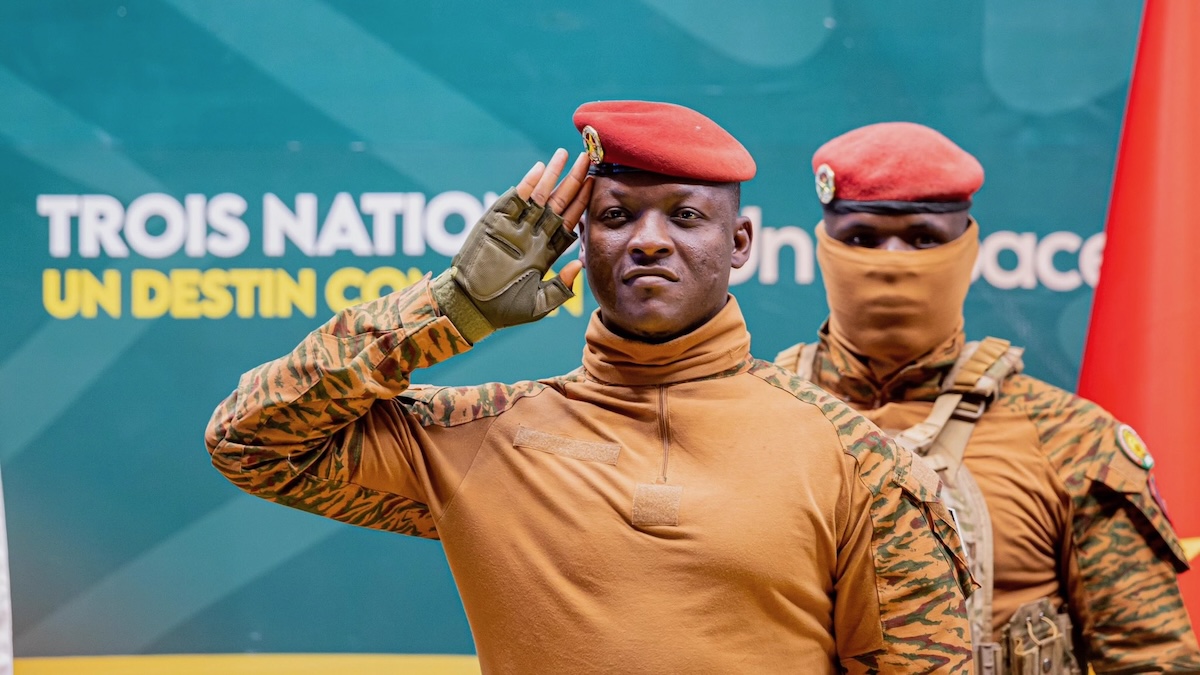
Ouagadougou (Diplomat.so) – Burkina Faso's military leader, Lt. Col. Ibrahim Traoré, declared on Thursday, that the country should "forget about democracy," signaling a potential long-term entrenchment of military rule.
Traoré, who seized power in a September 2022 coup, has consolidated authority by banning political parties and delaying elections initially scheduled for 2024.
Speaking to the state broadcaster Radiodiffusion Télévision du Burkina (RTB), Traoré said, "We’re not even talking about elections, first of all … People need to forget about the question of democracy … We must tell the truth, democracy isn’t for us.” He characterized democratic systems as violent and destructive, asserting that they result in civilian deaths and the targeting of hospitals and children.
Traoré, 37, rose to power by overthrowing a junta that had itself taken control nine months earlier. His government subsequently banned opposition parties in January and extended the transition period to 2029, citing security challenges from ongoing Islamist insurgencies.
Analysts describe Traoré’s rhetoric as a mixture of nationalist populism and anti-Western sentiment, often invoking the legacy of former revolutionary leader Thomas Sankara, who ruled Burkina Faso from 1983 until his assassination in 1987.
On the ground in Ouagadougou, residents expressed a mix of resignation and concern. Aminata Kaboré, a local teacher, told Diplomat News Network, "People are tired of promises. Security is worsening, but the idea of elections feels very far away.” Another resident, Moussa Sanou, said, "We hoped for democracy, but now we hear from the top that it’s not even a goal. It is worrying for our children’s future.”
Security remains the government’s primary justification for extending military rule. Burkina Faso has faced an Islamist insurgency since 2014, which displaced approximately 2.1 million people, around 9% of the population, according to official data from 2021.
Human Rights Watch (HRW) reported on Thursday that over 1,800 civilians had been killed since 2023 by the military, allied militias, and the al-Qaida-linked Jama’at Nusrat al‑Islam wa al‑Muslimin (JNIM). The group accused all parties of crimes against humanity, including targeted killings and forced displacement, particularly affecting Fulani communities.
Observers note that Traoré’s remarks mark a stark departure from prior commitments to a democratic transition and reinforce concerns over Burkina Faso’s political trajectory. Abdoulaye Sanou, a West Africa security analyst, said, "The junta’s justification hinges on insecurity, but shutting down political participation risks deepening instability and alienating international partners.”