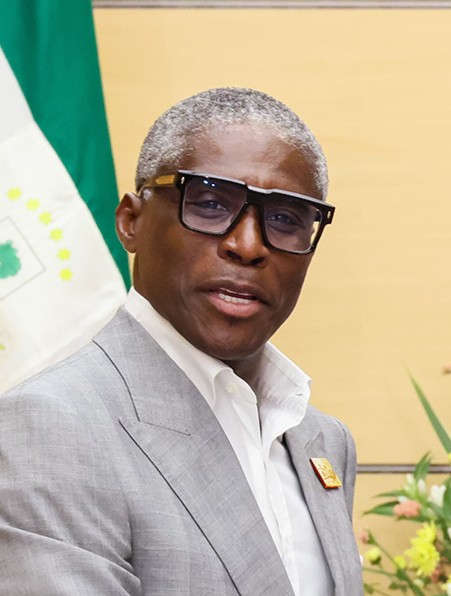
Malabo (Diplomat.so) - Government of Equatorial Guinea resigned on Tuesday, 17 June, after the prime minister submitted the collective resignation of ministers over failure to meet key performance targets, Vice-President Teodoro Nguema Obiang Mangue said.
Vice-President Teodoro Nguema Obiang Mangue, who is also the son of President Teodoro Obiang Nguema Mbasogo, said the outgoing administration had achieved barely 10% of its objectives, adding that the move reflected accountability in public management. "The principle that responsibility in public management must be accompanied by results,” he wrote on X. He added, "The degree of execution achieved is clearly insufficient in relation to the expectations and commitments undertaken.”
A statement from the ruling Democratic Party of Equatorial Guinea (PDGE) said President Teodoro Obiang Nguema Mbasogo had expressed dissatisfaction with the government’s performance, citing corruption, misuse of state resources, and failure to diversify the economy away from oil dependence. The statement also indicated that a new cabinet is expected to be appointed in the coming days to replace the outgoing administration.
President Obiang, the world’s longest-serving leader, has ruled the oil-rich Central African nation since 1979, maintaining a tight grip on political power while appointing family members to senior government positions. The outgoing cabinet, appointed in 2024 under Prime Minister Manuel Osa Nsue Nsua, faced sustained pressure over stalled development projects and limited progress in agricultural expansion and industrial diversification strategies intended to reduce reliance on hydrocarbons.
In Malabo, administrative activity continued under routine conditions on Wednesday, with security presence visible around key government buildings. Civil servants and officials were seen arriving for work as normal, while public spaces in the capital remained calm with no reported demonstrations or disruptions following the announcement.
The resignation highlights mounting governance pressures in a country heavily dependent on petroleum exports, where oil and gas account for most national revenue streams. Despite resource wealth, economic diversification has remained limited, contributing to persistent poverty affecting a significant share of the estimated 1.8 million population. The leadership reshuffle signals renewed attempts to enforce performance-based governance within a centralized political structure and highlights tensions between political loyalty and performance-based governance expectations within the ruling elite.
Diplomat News Network understands that the transition is expected to pave the way for a new cabinet tasked with accelerating reforms aimed at improving public sector efficiency and addressing long-standing concerns over corruption and economic diversification.