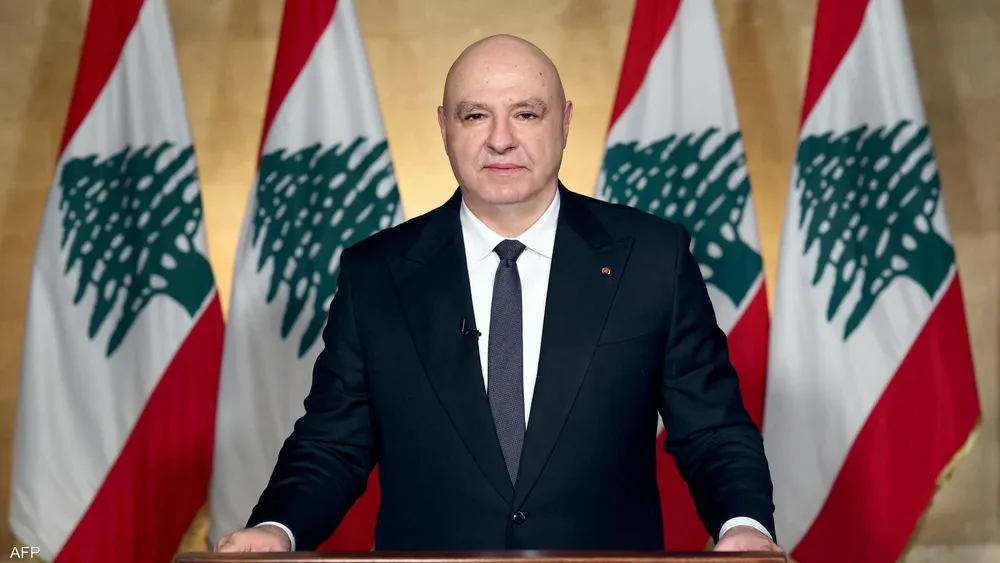
Beirut (Diplomat.so) – Lebanese Presidency President Joseph Aoun said on Friday, that Lebanon is "no longer an arena for anyone's wars," stating that the country has regained sovereign decision-making authority as ceasefire negotiations with Israel advance following days of intensified cross-border hostilities in southern Lebanon.
Speaking in a televised address broadcast from the presidential palace in Baabda, Aoun emphasized that ongoing talks are aimed at halting Israeli military operations and transitioning from a temporary ceasefire toward more durable security arrangements that would define the next phase of border stability.
He added that the negotiation process is being conducted under what he described as a national responsibility to protect sovereignty, insisting that Lebanon will not accept any compromise affecting its territorial integrity or political rights.
Sovereignty and Negotiation Position
Aoun reinforced that Lebanon’s political stance has shifted toward direct engagement on security arrangements, describing the current process as both sensitive and decisive.
He said: "The negotiations are precise and decisive, and the ceasefire is the entry point to move forward in them,” adding that the framework has received broad internal and international backing.
He further stated: "Lebanon has regained its decision for the first time in nearly half a century. The Lebanese are negotiating and deciding for themselves, and are no longer a card in anyone’s pocket.” The remarks reflect what officials describe as a recalibration of state authority amid long-standing regional tensions.
Ceasefire Implementation
The ceasefire agreement referenced by Aoun came into effect at midnight between Thursday and Friday, establishing a 10-day initial truce following weeks of escalation along the southern border.
The arrangement does not explicitly address long-term withdrawal mechanisms but is intended to open space for structured negotiations on security guarantees and border management.
Aoun confirmed that the Lebanese Armed Forces will be deployed in southern Lebanon once Israeli forces withdraw, stating that security control will rest exclusively with state institutions. "There will be no armed presence except the Lebanese Army and legitimate security forces,” he said, outlining a centralized security model as part of the proposed settlement framework.
According to reporting cited by Diplomat News Network, Lebanese officials view the ceasefire as a critical but fragile step, with ongoing diplomatic coordination involving international mediators and regional stakeholders.
Context of Southern Escalation
The latest diplomatic developments follow weeks of intensified exchanges along the Israel-Lebanon border, where cross-border fire and military strikes contributed to civilian displacement in southern communities.
Local residents in border villages described repeated evacuations and disrupted agricultural activity due to security concerns.
"We had to leave our homes twice in one week,” said one resident from the Marjayoun district, speaking on condition of anonymity. Another displaced trader in Tyre noted that "markets have slowed significantly, and uncertainty is affecting daily life more than the strikes themselves.”
International observers have linked the escalation to broader regional tensions, with spillover risks affecting civilian infrastructure and humanitarian access routes in southern Lebanon.
Regional Implications
Analysts view Aoun’s remarks as an attempt to consolidate state authority over security decision-making while signaling readiness for structured diplomacy. The emphasis on exclusive state control over armed forces aligns with long-standing Lebanese constitutional principles but has historically faced implementation challenges in areas with competing armed actors.
The ceasefire and ensuing negotiations are being closely monitored by regional and international actors, who see Lebanon’s stability as directly tied to wider security dynamics in the eastern Mediterranean.
Analysts note that sustained cessation of hostilities could open pathways for broader border agreements, though uncertainties remain over enforcement mechanisms and political guarantees.
The current phase is widely regarded as a critical test of Lebanon’s ability to translate ceasefire arrangements into lasting institutional security control, with attention now focused on whether negotiations can move beyond temporary de-escalation toward a formalized and enforceable settlement framework.