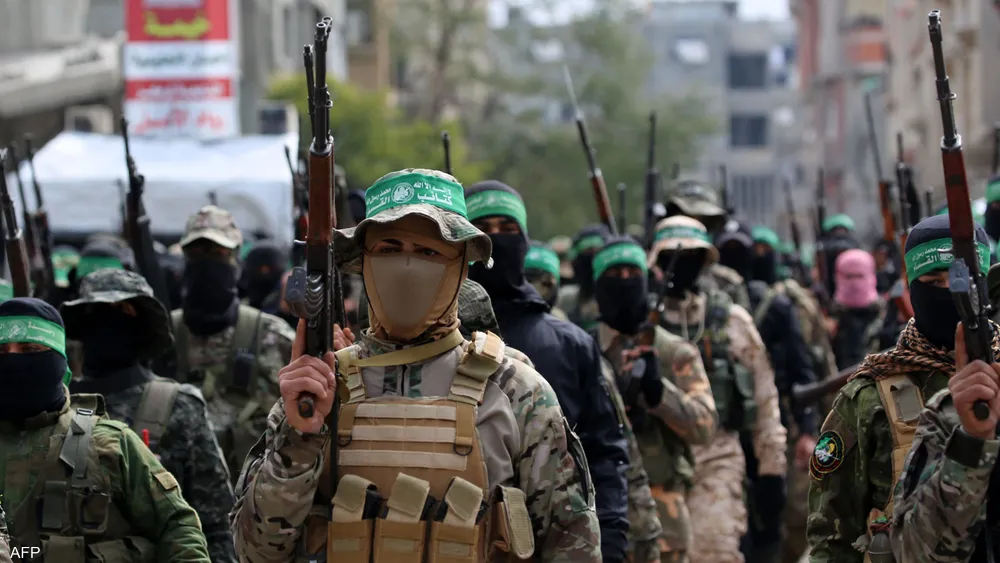
Gaza City (Diplomat.so) – The Al-Qassam Brigades, the military wing of Hamas, announced on Sunday, that the movement will not accept disarmament and issued stern warnings to Israel against interference with the Al-Aqsa Mosque and Palestinian prisoners in Israeli detention.
Abu Obaida, spokesperson for the Al-Qassam Brigades, made the statement in a televised address broadcast by Al-Aqsa TV, emphasizing that "raising the issue of our weapons in this blatant manner is nothing but a transparent attempt by the occupation to continue killing and exterminating our people, which we will under no circumstances accept.” He added that "what the enemy could not take from us with tanks and extermination will not be extracted through politics or negotiation tables.”
Abu Obaida further cautioned that Israeli efforts to push disarmament via intermediaries were "extremely dangerous” and urged mediators to pressure Israel to fulfill obligations under the first phase of the October 10 ceasefire agreement before discussing the second phase, which includes Israeli withdrawals and disarmament of Palestinian armed factions in Gaza.
A senior Hamas negotiator in Cairo, speaking to Diplomat News Network, said, "Our delegation led by Khalil al-Hayya engaged with Egyptian and Turkish officials last week to highlight Israel’s ongoing violations and to push for implementation of the first phase before entering discussions on the second.”
Hamas officials assert that the Palestinian side has "fulfilled its obligations fully and responsibly,” while accusing Israel of obstructing the ceasefire. Abu Obaida called on the United States to take responsibility for its perceived bias in the mediation process.
Abu Obaida also warned that any Israeli actions against Al-Aqsa or Palestinian prisoners "will not pass without consequences, regardless of the cost to our people,” and urged Palestinians in the West Bank, Jerusalem, and inside Israel to "mobilize toward Al-Aqsa.” He called on global supporters to stage demonstrations defending the mosque and Palestinian detainees.
In parallel, Gaza’s health authorities reported that an Israeli airstrike on Sunday killed four Palestinians in northern Gaza, near Deraj Street in Yafa, and injured several others. Medics confirmed that the strike targeted a group of individuals on the street. The Israeli military has not commented on the incident.
This latest escalation adds strain to the fragile ceasefire agreement reached in October 2025, which ended a two-year conflict. Both Hamas and Israel have accused each other of violations, complicating efforts by mediators from Egypt, Turkey, and other international actors to reinforce the truce.
Analysts emphasize the regional significance of these developments. Rania Lukman, a political analyst, told Diplomat News Network, "Hamas’s insistence on maintaining military capability reflects a strategic calculation to resist perceived Israeli coercion, while any breach at Al-Aqsa could spark broader unrest across occupied Palestinian territories and neighboring states.”
Background context highlights that tensions have been inflamed by recent Israeli legislative measures, including a law permitting capital punishment for Palestinian detainees convicted of terrorism-related offenses. Restrictions on Al-Aqsa access have also fueled protests and confrontations over the past weeks.
Observers note that continued airstrikes, coupled with political stalemates, threaten the stability of the October ceasefire and could prompt renewed violence. International mediators are now under pressure to secure concrete commitments from both sides, particularly regarding phased withdrawals and enforcement of previously agreed conditions.
The current environment underscores a delicate balance: Palestinian factions assert defensive rights and political leverage, while Israel maintains security measures it deems essential, leaving mediators to navigate a volatile landscape of legal, territorial, and humanitarian stakes.