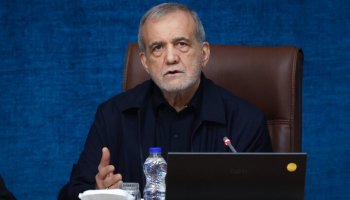
Tehran (Diplomat.so) - Masoud Pezeshkian, the President of Iran, convened the second meeting of the country's Provisional Leadership Council, joined by Judiciary Chief Gholamhossein Mohseni-Ejei and senior cleric Alireza Arafi, as Tehran projected institutional coordination amid heightened regional tensions and escalating rhetoric toward Washington.
Iranian state media reported that the council session focused on governance coordination and national priorities. No detailed communique was released, but the high-level attendance underscored efforts to present a unified leadership structure at a time of mounting geopolitical friction.
The meeting coincided with sharply worded remarks from Ali Larijani, who publicly criticized U.S. President Donald Trump over his Middle East policy stance. Writing on his official social media account, Larijani accused Trump of abandoning "America First” in favor of what he described as an "Israel First” approach, arguing that U.S. actions had deepened instability in the region.
"Trump's wishful thinking has dragged the whole region into an unnecessary war,” Larijani wrote, asserting that American resources were being expended to advance the ambitions of Israeli Prime Minister Benjamin Netanyahu. His comments reflect longstanding Iranian criticism of U.S.–Israel coordination on regional security matters.
There was no immediate response from U.S. officials to Larijani’s remarks. The Trump administration has consistently defended its Middle East strategy as strengthening American security interests and supporting key allies.
Political analysts note that the timing of the council meeting alongside Larijani’s public intervention suggests calibrated messaging. "When senior executive and judicial figures appear together, it signals institutional cohesion,” said a Tehran-based political affairs analyst in previously published commentary on Iranian governance dynamics.
Diplomat News Network reports that while the Provisional Leadership Council does not replace existing constitutional bodies, its visibility during periods of tension serves as a platform for strategic alignment and domestic signaling. Observers say such coordination often precedes broader diplomatic positioning as regional developments evolve.
The killing of Ali Khamenei in a direct U.S.–Israeli strike represents one of the most destabilizing scenarios imaginable in modern Middle Eastern geopolitics, with analysts warning such an event could trigger rapid regional escalation and a multi-front confrontation.
Under this hypothetical scenario, Iran’s constitutional chain of command would place immediate authority in the hands of senior state institutions, including the office of Masoud Pezeshkian, the President of Iran, alongside the Supreme National Security Council. Ali Larijani, Secretary of the Supreme National Security Council of Iran, would likely play a central role in coordinating military and diplomatic responses.
Security experts note that Tehran’s strategic doctrine emphasizes calibrated retaliation designed to impose costs while avoiding uncontrollable escalation. However, the assassination of a sitting Supreme Leader would cross a threshold unprecedented in the Islamic Republic’s history. "Such an action would almost certainly compel a direct and expansive response.”
The Strait of Hormuz, through which roughly a fifth of global oil supply transits, would likely become an immediate flashpoint, raising fears of energy market disruption and naval confrontation.