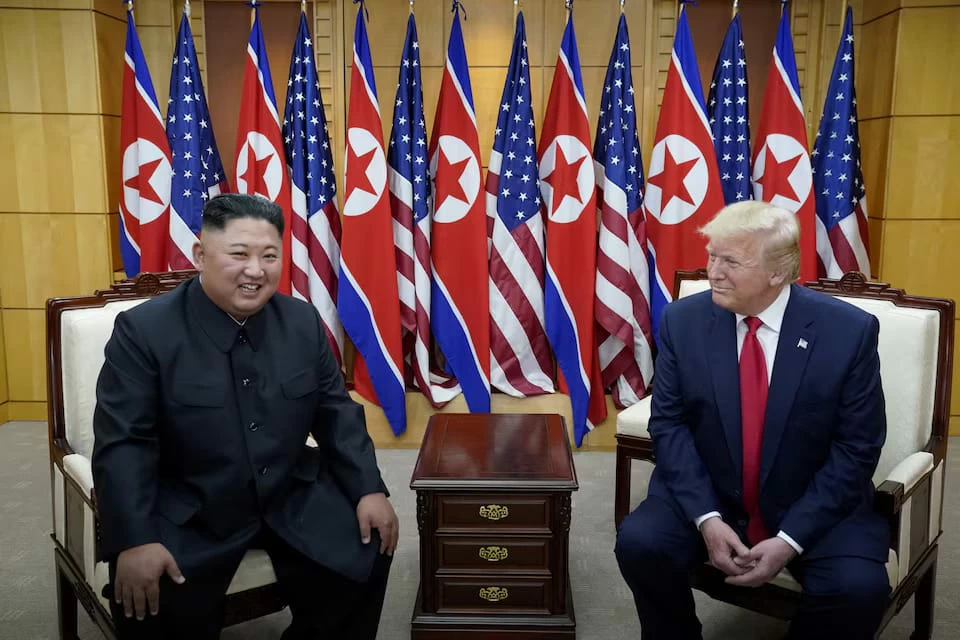
Washington, D.C. (Diplomat.so) - The U.S. Government said Wednesday, August 19, President Donald Trump wants renewed diplomacy with North Korea and expects another meeting with leader Kim Jong Un later this year.
Trump’s push follows his decision to scale back joint military exercises between the United States and South Korea, which he described as hostile toward North Korea. Washington has presented the move alongside renewed calls for dialogue, though no summit date or formal negotiating process has been announced.
A U.S. State Department spokesperson said Washington remains open to talks with Pyongyang "without preconditions,” adding that Trump and Kim could meet again "at the appropriate time.” The department also reaffirmed that the United States remains committed to the complete denuclearization of North Korea.
Pyongyang responded cautiously. Kim Yo Jong, Kim Jong Un’s sister and a senior North Korean official, acknowledged what she described as an "excellent” personal relationship between Trump and her brother but said those ties could not come at the expense of North Korea’s security interests.
Kim Yo Jong also rejected suggestions that recent U.S. measures represented sufficient goodwill to restart negotiations. She criticized continuing U.S.-South Korean military exercises and denied that recent direct communication had taken place between Trump and Kim.
Military tensions accompanied the diplomatic exchanges. South Korea’s military said North Korea launched about 10 ballistic missiles toward waters off its eastern coast, highlighting the continuing security divide as Washington attempts to reopen communication.
Jenny Town, a senior fellow at the Stimson Center, said North Korea could demand substantial changes in U.S. policy before returning to negotiations, potentially including the removal of measures Pyongyang considers hostile and changes to Washington’s approach to North Korea’s nuclear status.
Diplomat News Network’s review of the developments shows that nuclear policy remains the principal obstacle to renewed negotiations. Washington continues to call for North Korea’s complete denuclearization, whereas Pyongyang has increasingly portrayed its nuclear arsenal as central to national security.
Trump and Kim have met face-to-face three times. Their first meeting took place on June 12, 2018, at the Capella Hotel on Sentosa Island in Singapore, marking the first summit between a sitting U.S. president and a North Korean leader. They signed a joint statement addressing bilateral relations, security guarantees and denuclearization of the Korean Peninsula.
Their second meeting was held on February 27-28, 2019, at the Metropole Hotel in Hanoi, Vietnam. The summit ended without an agreement after negotiations broke down over North Korea’s proposed nuclear measures and the extent of sanctions relief Washington was prepared to provide.
Trump and Kim met a third time on June 30, 2019, at Panmunjom in the Korean Demilitarized Zone, where Trump crossed the military demarcation line and briefly entered North Korea, becoming the first sitting U.S. president to do so. The leaders agreed to restart working-level negotiations, but subsequent talks failed to produce a lasting agreement.
The regional environment has since shifted. North Korea has strengthened relations with Russia and retained close economic and political ties with China, expanding Pyongyang’s alternatives as it faces U.S.-led sanctions and reducing incentives for immediate concessions.
Hong Min, a researcher at the Korea Institute for National Unification, said Kim Yo Jong’s message appeared to leave room for future diplomacy while pressing Washington to adopt a more flexible approach.
The latest exchanges leave dialogue possible but underscore the distance separating the two governments. A new Trump-Kim meeting would restore direct leader-level diplomacy, but substantive negotiations would still depend on whether Washington and Pyongyang can narrow their differences over nuclear weapons, sanctions and regional military policy.